GLP-1s Were Made To Help, So Why The Stigma?
Americans support GLP-1s more than headlines suggest, but stigma and misinformation still shape public perception.

GLP-1 medications were originally developed to help manage type 2 diabetes, but lately, they’ve become one of the most polarizing topics in health culture. From celebrity headlines to TikTok debates, conversations about these medications often focus more on appearance than the chronic conditions they were designed to treat. That shift has left many Americans navigating a confusing mix of medical facts, misinformation, and judgment.
To better understand how people really feel about GLP-1 medications, ZipHealth surveyed 993 Americans about awareness, stigma, insurance coverage, and public perception. The results revealed a major disconnect between what people know about GLP-1s and how they talk about those who use them.
Key takeaways
- 4 out of 5 Americans now associate GLP-1s primarily with weight loss, even though 72% know they were originally developed to treat type 2 diabetes.
- 71% of Americans call GLP-1s a meaningful medical breakthrough, a number that climbs to 96% among current users.
- 65% of Americans agree that weight loss stigma has unfairly shaped how the public views GLP-1 medications, even when prescribed for diabetes.
- 67% of Americans say insurance should be required to cover GLP-1s for obesity the same way it covers other chronic disease treatments.
- 61% of Americans say GLP-1s are necessary for general healthcare, not a shortcut.
From diabetes treatment to TikTok trend: what Americans really know about GLP-1s
The conversation around GLP-1 medications has moved fast, but public understanding has not always kept up. While awareness is high, many Americans are still sorting through misinformation, viral content, and conflicting opinions about what these medications actually do.
GLP-1 knowledge gaps
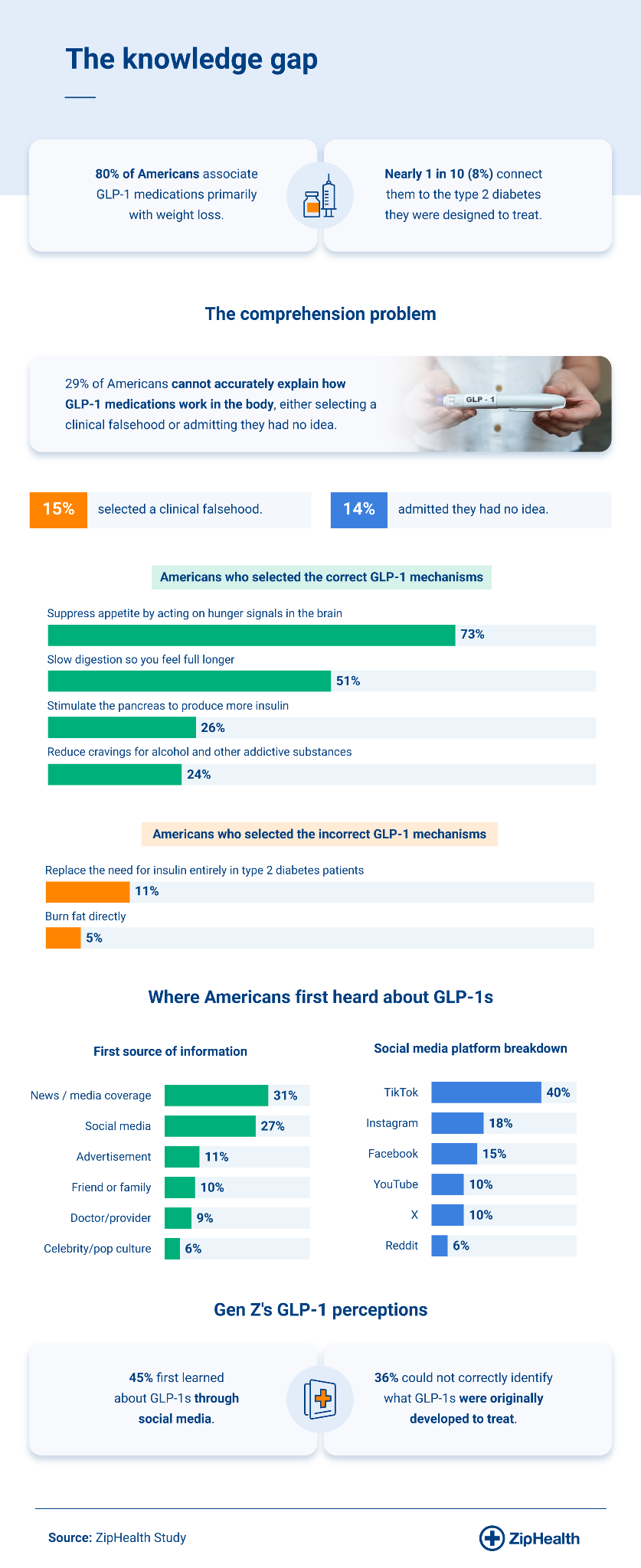
- Eight in 10 Americans associate GLP-1 medications primarily with weight loss, even though 72% know they were originally developed to treat type 2 diabetes.
- More than 1 in 4 Americans (28%) don’t know GLP-1 medications were originally developed for type 2 diabetes rather than weight loss.
- Gen Z is the least informed generation, with 36% answering incorrectly.
- Men trail women by 15 percentage points in awareness (62% vs. 77%).
Social media is driving awareness
- More than 1 in 4 Americans (27%) first learned about GLP-1 medications through social media.
- TikTok accounts for 40% of that exposure, rising to 45% among Gen Z.
Confusion around how GLP-1s work remains common
- Nearly 3 in 10 Americans (29%) cannot accurately explain how GLP-1 medications work.
- About 15% selected a clinical falsehood, while 14% admitted they had no idea.
- More than a quarter of current GLP-1 users (27%) cannot accurately explain how the medication they are taking works.
Americans remain uncertain about safety and legitimacy
- More than 1 in 3 Americans (35%) believe GLP-1 medications are addictive. Another 37% say they are unsure, while only 26% actively disagree.
- Nearly 1 in 5 Americans (16%) do not consider clinically diagnosed obesity as a valid medical reason for a GLP-1 prescription.
Why the stigma around GLP-1s still runs deep
Public opinion about GLP-1 medications is often shaped by more than science alone. Social pressure, celebrity culture, and longstanding attitudes about weight all continue to influence how people view those who use these treatments.
Americans are divided on whether GLP-1s are a “shortcut”
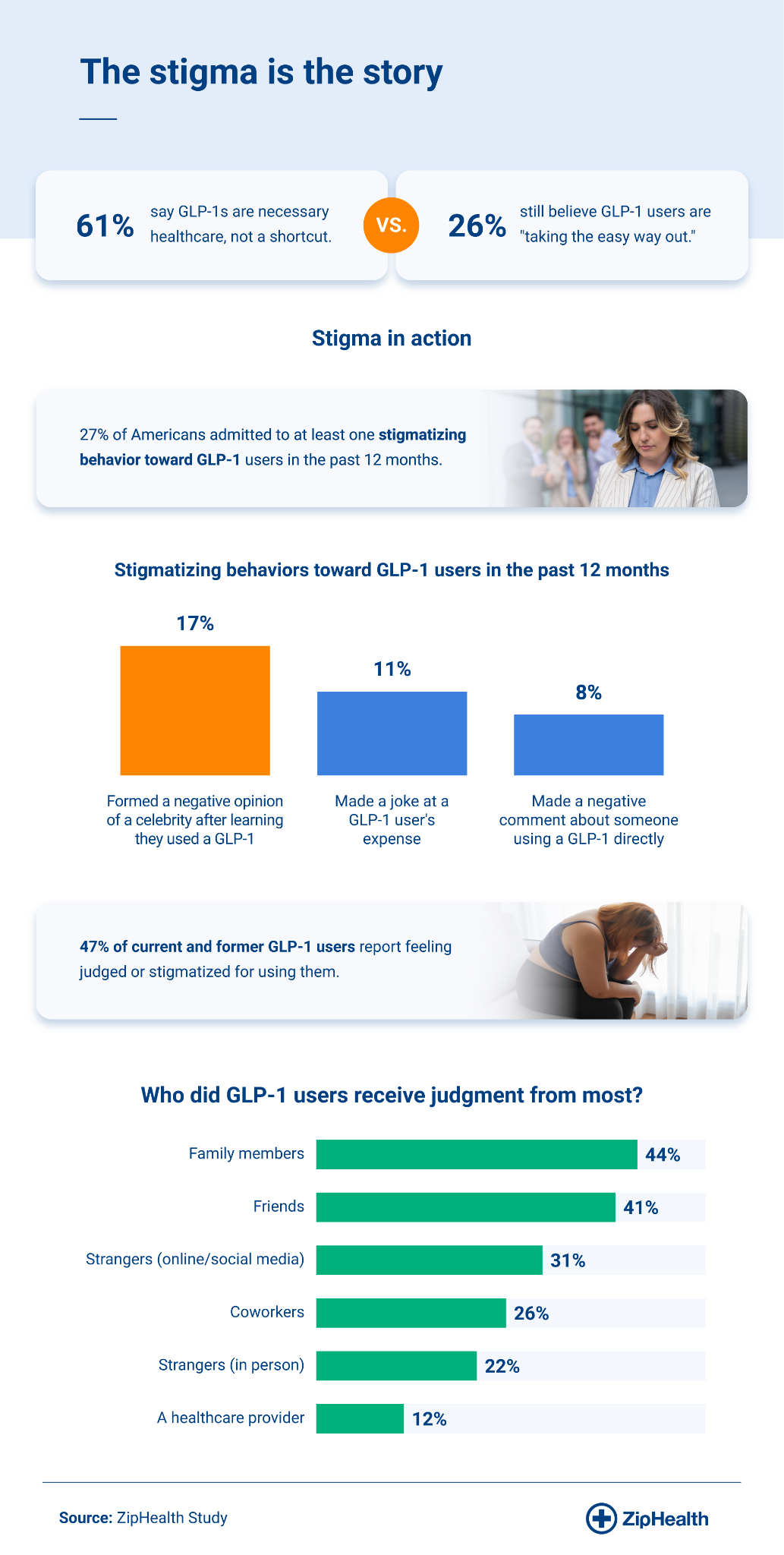
- While 61% of Americans say GLP-1s are necessary for general healthcare and not a shortcut, 26% believe users are taking the easy way out.
- Among current users, only 8% agree.
- Nearly 2 in 3 Americans (65%) agree that weight loss stigma has unfairly shaped how the public views GLP-1 medications, even when prescribed for diabetes.
Stigmatizing behavior is still common
- More than 1 in 4 Americans (27%) admit to at least one stigmatizing behavior toward GLP-1 users in the past year.
- 17% formed a negative opinion of a celebrity after learning they used a GLP-1.
- 11% made a joke at a GLP-1 user’s expense.
- 8% made a negative comment directly.
Many GLP-1 users feel judged by people close to them
- Nearly 1 in 2 current or former GLP-1 users (47%) report feeling judged or stigmatized.
- Family members were the top source of judgment at 44%, with friends closely behind at 41%.
Insurance opinions shift with personal experience
- Nine in 10 current GLP-1 users believe insurance should be required to cover GLP-1s for obesity treatment.
- Among Americans with no personal or close connection to the medication, support drops to 55%.
Some Americans keep GLP-1 use private
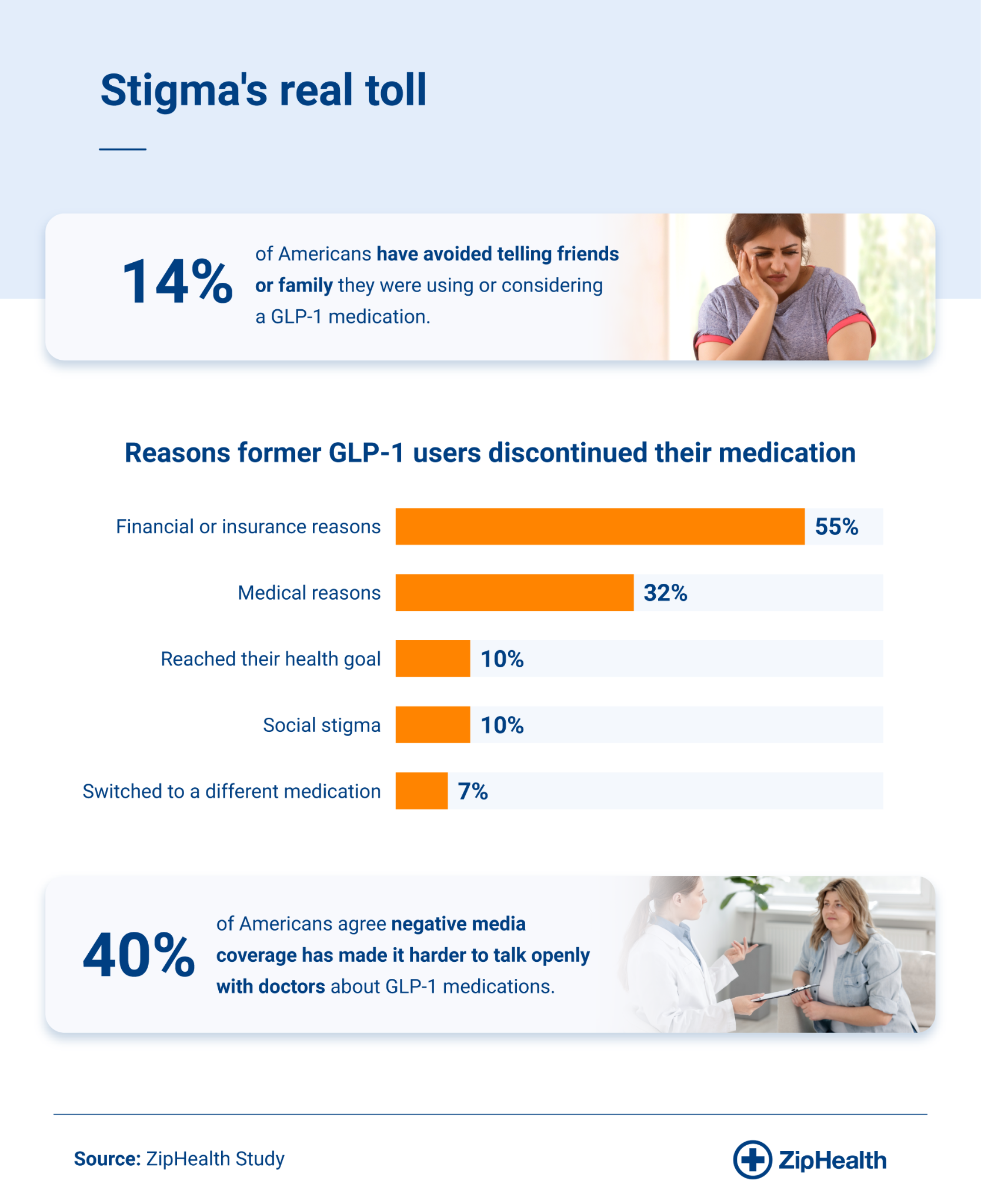
- Fourteen percent of respondents avoided telling friends or family they were using or considering a GLP-1 medication.
- Another 13% admit they viewed someone more negatively after learning they used medication for weight loss.
- The same percentage (13%) say they would judge someone more harshly for using a GLP-1 for weight loss than for diabetes treatment.
Cost remains the biggest barrier
- While 1 in 10 former GLP-1 users (10%) cite stigma as a reason for stopping, over half (55%) stopped taking the medication because of financial or insurance-related reasons.
Negative media coverage may be affecting doctor conversations
- Two in 5 Americans (40%) agree that negative media coverage makes it harder to openly discuss GLP-1 medications with doctors. Among Gen Z, that number rises to 51%.
Fear of judgment keeps some people from speaking up
- Half of respondents uncomfortable raising GLP-1s with a doctor cite a stigma-related concern.
- 21% mention embarrassment.
- 17% worry about being seen as lazy.
- 16% fear their doctor would not take them seriously.
- 14% fear being judged directly by their doctor.
- 7% worry about how a prescription might look to others.
GLP-1s deserve a more informed conversation
GLP-1 medications sit at the intersection of healthcare, culture, and personal identity, which may explain why conversations around them have become so emotionally charged. While most Americans recognized these medications as an important medical advancement, many still carried misconceptions about who uses them and why.
The findings show that stigma often grows where information is incomplete. Social media, celebrity coverage, and public opinion continue to shape how people talk about GLP-1s, sometimes more loudly than medical facts do. At the same time, millions of Americans increasingly view these medications as legitimate tools for managing chronic health conditions.
That gap between perception and reality has real-world consequences. People are hiding their prescriptions from family, struggling to talk openly with their doctors, and in some cases stopping treatment altogether.
Healthcare shouldn't feel that hard. At ZipHealth, we believe access to treatment should be judgment-free, and that includes GLP-1 medications. Through convenient online consultations and discreet, overnight delivery, we make it easier for patients to get the care they need without navigating the stigma that too often gets in the way.
Methodology
ZipHealth surveyed 1,003 US adults via CloudResearch Connect in May 2026 to explore public attitudes, stigma, and understanding surrounding GLP-1 medications. Respondents were recruited using a quota system to ensure representation across GLP-1 users and non-users. After removing incomplete responses and duplicate participant IDs, the final usable sample included 993 respondents. The margin of error was +/- 3.1 percentage points at the 95% confidence level. Percentages may not total 100% due to rounding.
Sample demographics included millennials (50%), Gen X (27%), Gen Z (15%), and baby boomers (8%). Respondents identified as women (64%), men (35%), and non-binary (1%). About 21% currently take a GLP-1 medication, 11% formerly took one, 31% had no personal prescription but knew someone close who does, and 36% reported no personal or close connection to GLP-1 medications.
About ZipHealth
At ZipHealth, we believe healthcare should feel accessible, supportive, and judgment-free. We provide convenient online care for a range of health concerns, helping patients access trusted treatments from the privacy of home. As conversations around weight management and chronic health continue to evolve, ZipHealth remains committed to making healthcare simpler, more informed, and easier to navigate.
Fair use statement
This content is available for noncommercial use only. If you share or reference this article, please provide proper attribution and include a link back to ZipHealth.