WeightLoss on TikTok: What’s Trending, What’s Misleading, and What Actually Works
New research from ZipHealth breaks down which weight-loss hashtags get the most attention on TikTok, what creators are saying, and what it means for your health decisions.


If you've ever gone down a weight-loss rabbit hole on TikTok, you know how fast it gets overwhelming. One video swears by intermittent fasting. The next is all about GLP-1s. ZipHealth analyzed thousands of the most viewed videos across 19 popular weight-loss hashtags to make sense of what's out there. We looked at what gets watched and said, and what it all means for your health decisions.
Key Takeaways
- #WeightLoss TikToks are the most watched and liked in the study, with a typical popular video reaching 10.25M views and 1.48M likes.
- #WeightLossMotivation ranks 5th in median views (3.67M) but earns the 2nd highest median likes at 680.7K.
- #Mounjaro and #GLP1 lead among medication-specific hashtags, with median views of 435.7K and 368.5K, respectively.
- The terms "fasting," "intermittent," and "autophagy" dominate diet and behavior content. The first two appear 22x more than in other categories, and "autophagy" isn't used anywhere else.
What's trending on weight-loss TikTok
TikTok's weight-loss conversation spans everything from calorie counting to prescription medications, but its reach is far from evenly distributed. We measured the median views and likes of the most-viewed videos under each hashtag to see which corners of the conversation command the most attention.
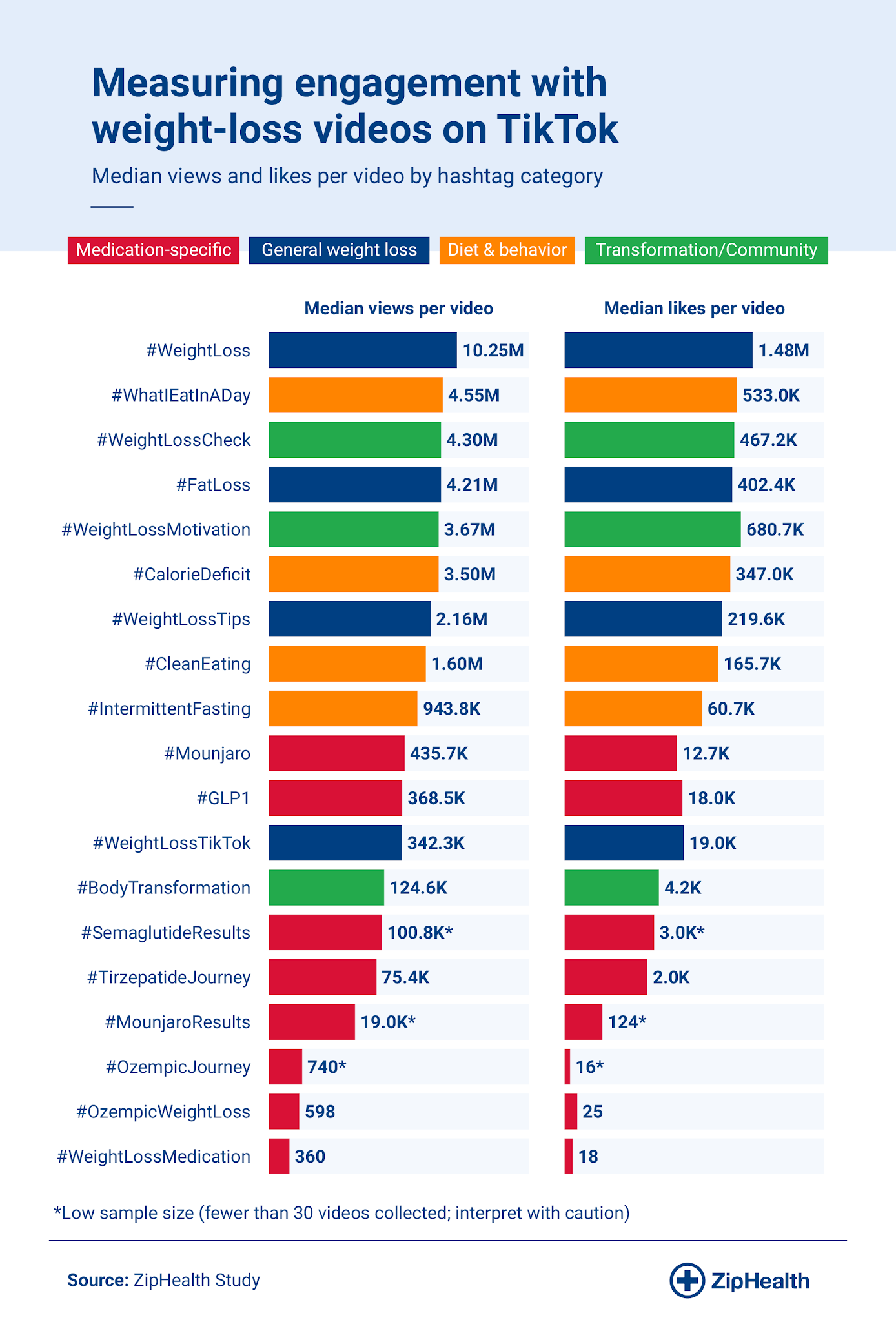
General weight-loss content is what most people watch. The typical popular #WeightLoss video drew 10.25M views, more than double any other hashtag in the study. Two other tags in this category had millions of views: #FatLoss (4.21M) and #WeightLossTips (2.16M). This kind of reach means general weight-loss content sets the tone for what most people believe about losing weight.
A few diet/behavior and transformation/community tags also reached millions of views per video, including:
- #WhatIEatInADay: 4.55M
- #WeightLossCheck: 4.30M
- #WeightLossMotivation: 3.67M
- #CalorieDeficit: 3.50M
- #CleanEating: 1.60M
Likes followed a similar pattern, except for #WeightLossMotivation. Though it ranked 5th overall in views, it ranked second in likes at 680.7K. This suggests that motivational content resonates, with viewers more likely to engage when they feel inspired.
Medication-specific hashtags told the opposite story. The typical video under tags like #OzempicWeightLoss and #WeightLossMedication had fewer than 1,000 views. Despite the widespread attention weight-loss medications have received, this corner of TikTok was comparatively quiet in our sample.
This low reach and engagement may reflect just how hard it can be to find reliable information about prescription weight-loss treatments. GLP-1 medications require clinical evaluation, and that conversation is better had with a licensed provider than on a "For You" page.
What's said the most on weight-loss TikTok
Beyond the hashtags, we analyzed what creators actually say by pulling the most frequent words from video transcripts in each category. Because words were counted separately within each category, the same term can appear across all four, and often does.
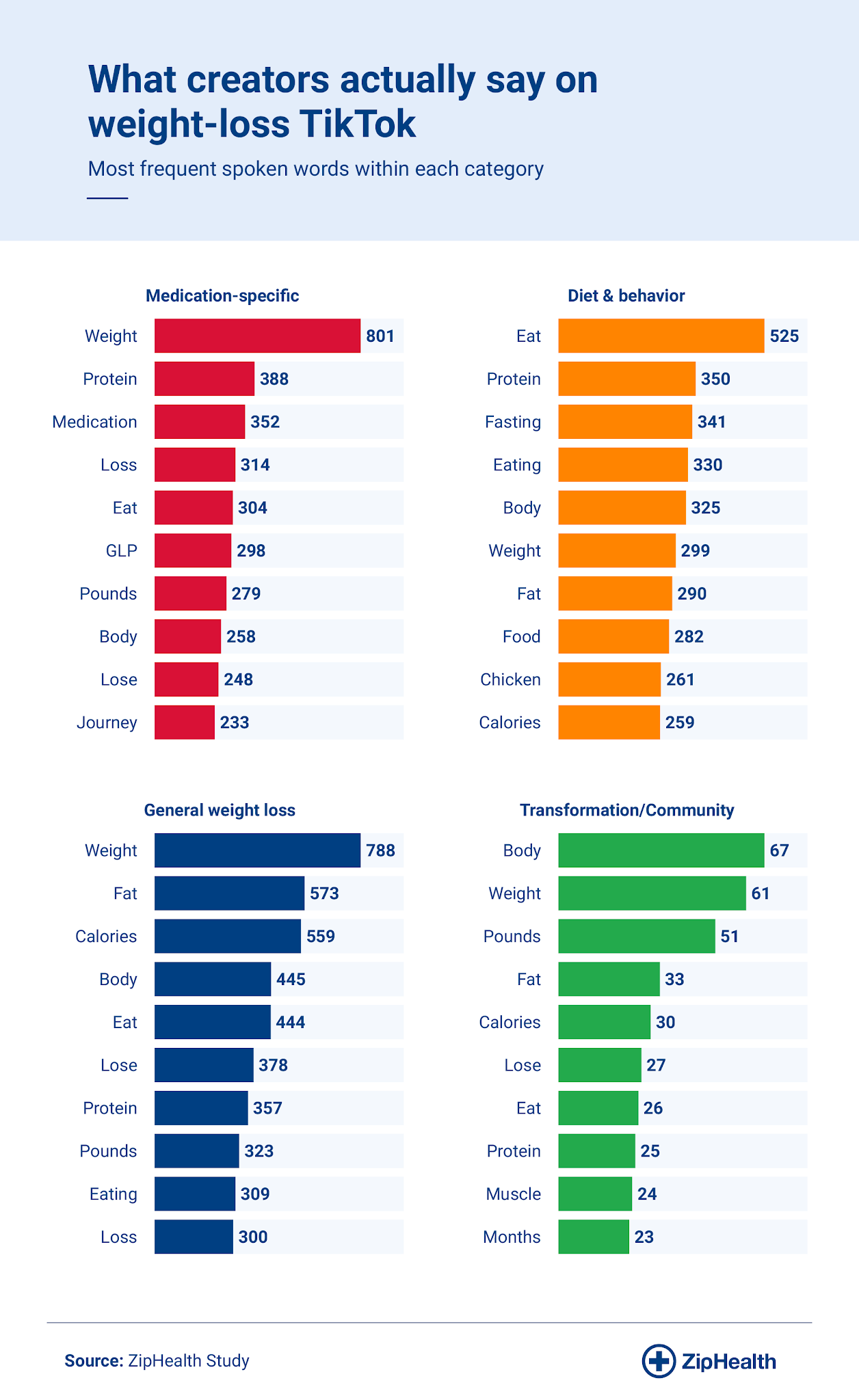
No matter the hashtag, the conversation orbits the same core vocabulary. "Weight," "body," "protein," "eat," and "calories" appear near the top of every category. Regardless of angle, weight-loss TikTok keeps returning to the same fundamentals.
Diet and behavior content is also often about "fasting," "chicken," and "food," while general weight-loss content is where "fat" and "calories" get mentioned more. Medication-specific transcripts bring in mentions of "GLP." "Journey" also ranks in that category's top 10, suggesting creators in that space are framing weight loss as a longer, more personal process.
But shared vocabulary doesn't mean shared experience. Weight loss looks different for everyone, and figuring out the right approach is easier with a clinician than an algorithm. ZipHealth connects patients with licensed providers who can assess their individual needs and, where appropriate, prescribe treatments like compounded liraglutide.
What sets each corner of weight-loss TikTok apart
To find what truly distinguishes each category, we identified the words that appear far more in one category than in all the others combined, stripping out shared terms like "weight" to reveal each group's signature vocabulary.
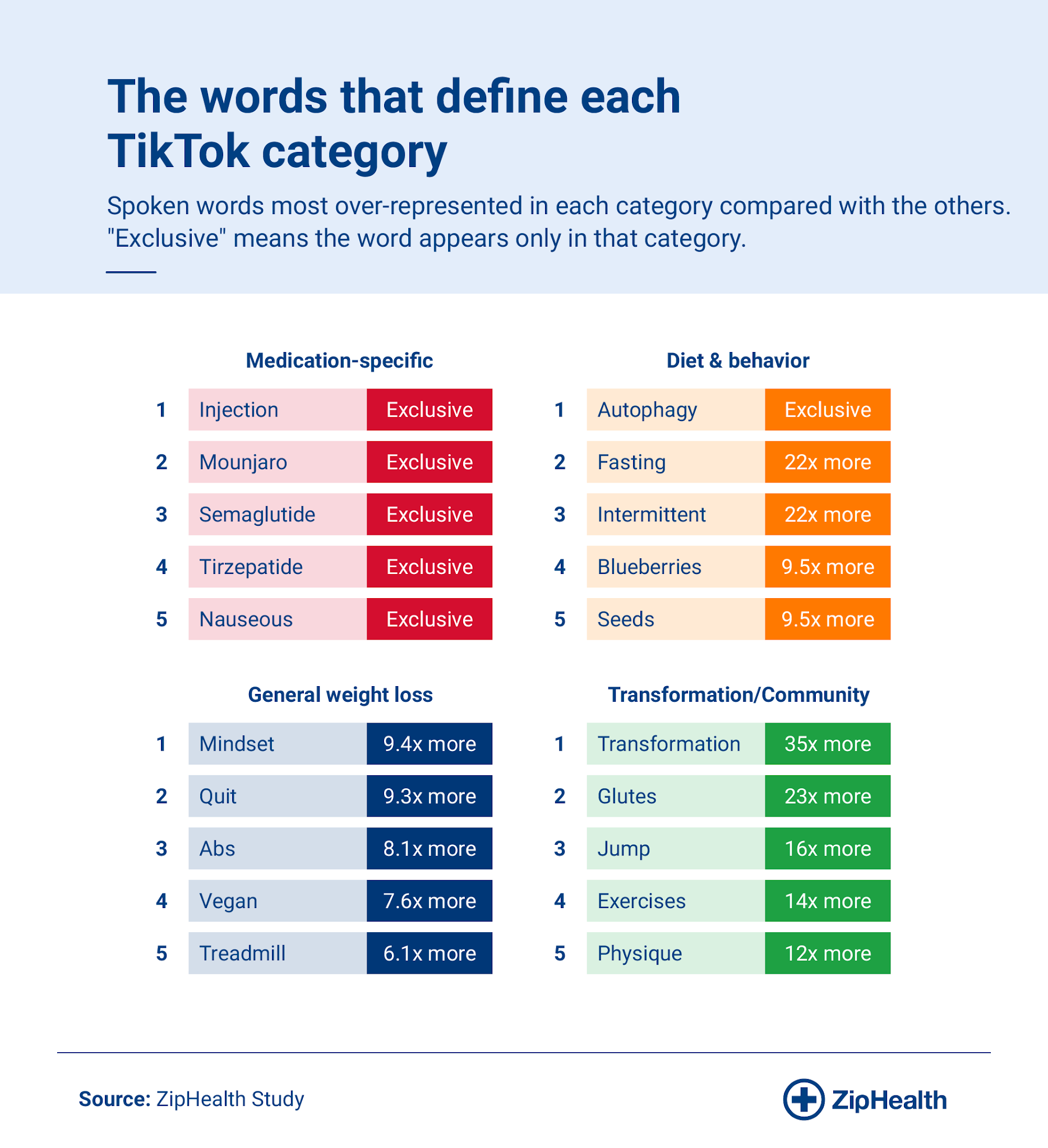
Medication content has the most exclusive language of all. Every one of its top 5 distinctive words (injection, Mounjaro, semaglutide, tirzepatide, and nauseous) appeared in medication transcripts only. The presence of "nauseous" suggests that side effects are also part of the conversation. GLP-1 side effects can occur, but they're also manageable, and a licensed clinician can help you know what to expect.
As for diet content, intermittent fasting defines this category. "Fasting" and "intermittent" appear 22x more here than elsewhere. And "autophagy," the body's process of breaking down and recycling damaged cells (a concept associated with fasting), doesn't show up anywhere else.
Transformation content was defined by physical-effort language, with "transformation" (35x), "glutes" (23x), and "exercises" (14x) leading the way. General weight-loss content skewed motivational, led by "mindset" (9.4x), "quit" (9.3x), and "vegan" (7.6x).
The bottom line
Weight-loss TikTok turns out to be both more uniform and more divided than it first appears. Nearly every category leans on the same core vocabulary of food, calories, and the body, yet each has a signature language that sets it apart.
What the data can't capture is whether any of it is accurate. A hashtag's popularity says nothing about the quality of the advice inside it, and the most-viewed video isn't always the most reliable one.
For anyone navigating weight loss, TikTok can be a starting point, but it's not a substitute for clinical guidance. ZipHealth connects patients with licensed providers who can cut through the noise, answer questions, and prescribe treatments, all without an in-person visit.
Methodology
We gathered 6,496 TikTok videos under 19 weight-loss-related hashtags, then grouped them into four categories:
- Medication-specific: #GLP1, #OzempicWeightLoss, #OzempicJourney, #SemaglutideResults, #MounjaroResults, #Mounjaro, #TirzepatideJourney, #WeightLossMedication
- General weight loss: #WeightLoss, #WeightLossTikTok, #WeightLossTips, #FatLoss
- Diet and behavior: #CalorieDeficit, #IntermittentFasting, #CleanEating, #WhatIEatInADay
- Transformation/Community: #BodyTransformation, #WeightLossMotivation, #WeightLossCheck
This reflects how a video was collected, not what it is necessarily about; a video collected under #Mounjaro may never mention the drug. After removing duplicate videos, we worked with 6,159 unique videos.
We targeted up to 500 videos per hashtag. Videos were collected in order of popularity, so the sample skews toward the most-viewed content under each hashtag rather than a random cross-section. As a result, the median figures describe a typical high-performing video, not a typical video overall.
For engagement, we report the median views and median likes per video for each hashtag, the typical-video figure, rather than averages, so a handful of mega-viral videos don't distort the numbers. Each video is counted once, under a single category.
For the analysis of what creators say, we used the spoken-word transcripts of each video, cleaned to remove timestamps and formatting. We limited this analysis to the 1,954 videos with available English-language transcripts, then counted word frequencies within each category after removing common filler words (the, and, is, and similar). Counts are totals, so a single video may contribute a word more than once. To identify each category's most distinctive words, we compared how often a word appears in one category versus all others combined; words common everywhere, like weight and body, fall away, surfacing the vocabulary unique to each category.
Limitations: We measured what videos say, not whether claims are true or medically sound. Raw word counts partly reflect category size, so counts should be compared within a category rather than across them. About 25.1% of videos (1,543) were flagged as non-English and excluded from the word-frequency analysis, with Portuguese and Spanish detected most thoroughly and Vietnamese, Arabic, and Malay/Indonesian detected less completely. Views are cumulative, so older videos have had longer to accumulate them. Because we collected the most-viewed videos per hashtag, these figures reflect popular content, not a random or complete sample of weight-loss TikTok. View and like counts are therefore higher than a typical random video would show.
About ZipHealth
ZipHealth provides convenient, clinician-led online consultations and prescription treatments, including compounded liraglutide + B12. No insurance is required, and treatments are delivered fast and discreetly. Start your quick online consultation today.
Fair use statement
This research may be shared freely for noncommercial use. If you reference or cite these findings, please attribute them to ZipHealth and include a link back to the original article.