The Bedroom Breakup Index: When Silence Ends Relationships
A new ZipHealth survey reveals how sexual incompatibility silently ends relationships, and why most people never seek help.

Sexual compatibility isn't exactly pillow talk, but maybe it should be. A new ZipHealth survey of more than 1,000 US adults found that intimacy-related issues are quietly dismantling relationships across the country, not through dramatic confrontations, but through silence, withdrawal, and unspoken frustration.
From mismatched libidos to health concerns like erectile dysfunction, chronic pain, and anxiety, this research reveals how often Americans let bedroom struggles fester until they become relationship-ending problems.
Key takeaways
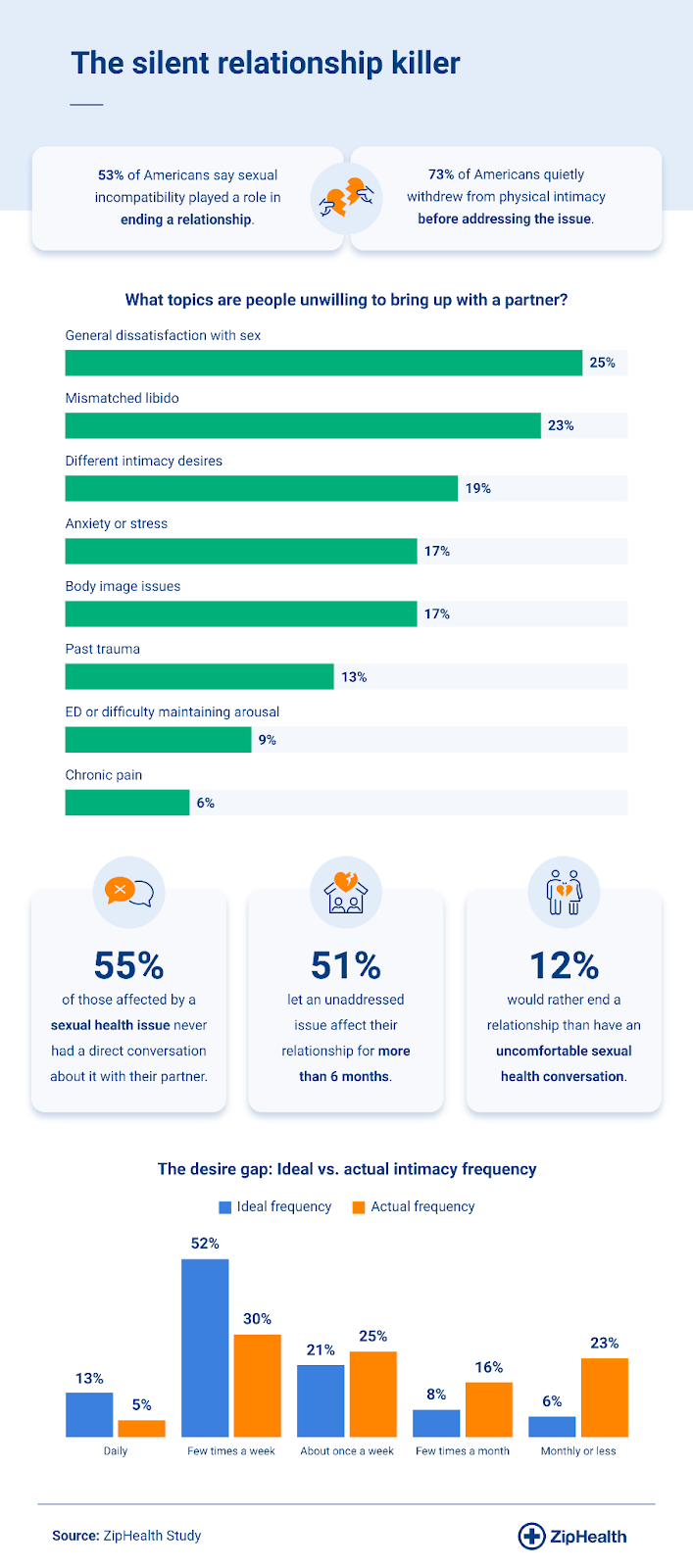
- More than half of Americans (53%) say sexual incompatibility has ended or damaged a relationship for them.
- 55% of those affected by a sexual health issue never had a direct conversation about it with their partner.
- Nearly three-quarters of Americans (73%) say they withdrew from physical intimacy rather than confronting the problem, while just 19% addressed it head-on.
- A majority of Americans (55%) say they are not getting as much physical intimacy as they want.
- 65% desire physical intimacy frequently (daily or a few times a week), but only 35% are experiencing it that often.
- Despite the impact, 80% of Americans have never sought professional help for a sexual health concern affecting their relationship.
- 60% of Americans say discreet telehealth would make them more likely to seek help, but 17% had no idea this option exists.
- Among the 7% of Americans who have turned to AI chatbots for sexual health advice, 89% say it helped, outperforming close friends (86%) and therapists (76%).
When sexual health issues go unaddressed in relationships
- 83% of Americans say sexual compatibility is essential to a relationship's survival, yet 69% believe most couples wait too long to even talk about it.
- 51% of Americans let an unaddressed sexual health issue go on for more than 6 months before anything changed, and 29% say they did so for more than a year.
- 55% of those affected by a sexual health issue never had a direct conversation about it with their partner: 18% only hinted at it, and 37% walked away without raising it at all.
- 73% of Americans withdrew from physical intimacy before the relationship ended or addressed the problem. Only 19% dealt with it head-on.
- Women were more than twice as likely as men to quietly withdraw from intimacy before the relationship ended (48% vs. 21%). Men were nearly twice as likely to address the issue directly (27% vs. 15%).
- 55% of Americans aren't getting as much physical intimacy as they want, including 60% of men and 51% of women.
- 65% of Americans want sex frequently (daily or a few times a week), but only 35% actually experience it. Men feel the gap more than women:
- Men: 76% want frequent intimacy, but only 38% get it.
- Women: 59% want it, but just 34% experience it.
Generational differences
- Gen X is the most likely to link sexual incompatibility to breakups (23%), ahead of millennials (21%), baby boomers (18%), and Gen Z (16%).
- 67% of Gen Z want frequent intimacy, and 40% get it. They were also the least likely to say they aren't getting as much sex as they want (49%).
- 63% of Gen X adults want frequent intimacy, but only 30% get it, and 62% say they're falling short.
- 59% of baby boomers want frequent intimacy, but just 25% get it; 35% have sex once a month or less, and they're the least likely to seek sexual health solutions (39%).
When sexual health issues go unspoken, they rarely stay small. Over time, silence can create distance, frustration, and a loss of confidence for both partners. What might begin as a manageable concern can slowly affect how people connect, both physically and emotionally.
The good news is that many of these challenges are treatable, and support is more accessible than many people realize. Discreet options like telehealth make it easier to address sensitive concerns privately, which can help people take that first step toward improving both their sexual health and their relationship.
The topics couples are too uncomfortable to discuss
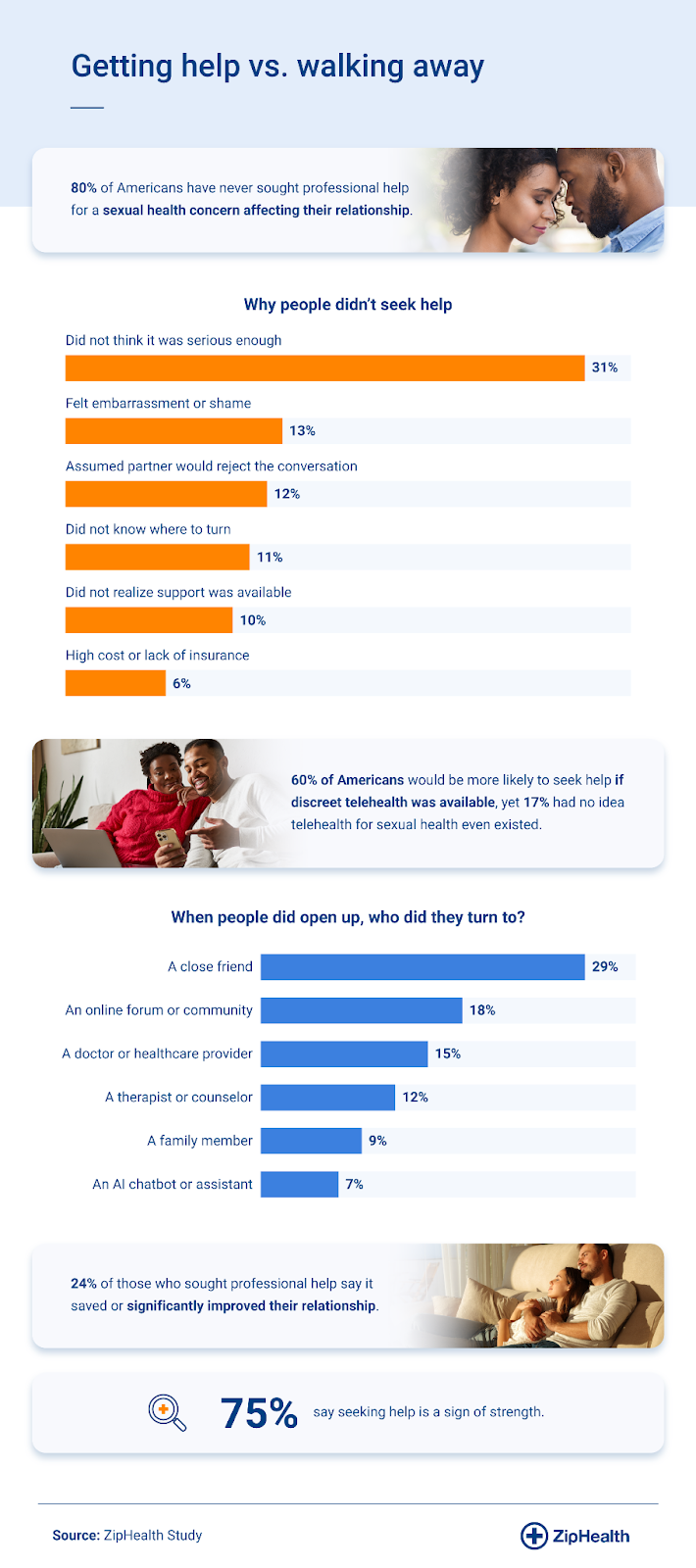
- Men and women sought professional sexual health help at identical rates (12% each), yet 80% of all Americans never sought help at all.
- The top reason people did not seek help: 31% did not think the issue was serious enough.
- 21% of Americans either did not know where to turn for sexual health support (11%) or did not realize that support was even available (10%).
- 42% of Americans who faced a sexual health or intimacy concern dealt with it without telling a friend, partner, or professional.
- 7% of Americans have turned to AI chatbots for sexual health advice, and 89% say it helped, outpacing close friends (86%) and therapists (76%).
- Millennials (63%) and Gen X (60%) were far more open to discreet telehealth than baby boomers (39%), who were the least likely generation to say it would change their behavior.
- 51% of Americans have already used telehealth for other health concerns, but have never used it for sexual health.
- 27% of Americans say better awareness of telehealth for sexual health would have changed the outcome of a past relationship for them.
Avoiding these conversations can feel easier in the moment, but it often comes at the cost of a deeper connection. Topics like desire, performance, or discomfort are closely tied to vulnerability, which makes them harder to bring up.
With services like ZipHealth, access to care does not have to be another barrier. By offering online consultations with licensed providers and discreet delivery of medication, ZipHealth makes it easier to address sensitive concerns privately and take meaningful steps toward improving both sexual health and relationship confidence.
Methodology
ZipHealth commissioned an online survey of 1,002 US adults via CloudResearch Connect in 2026. Participants were recruited from a nationally distributed panel, with safeguards in place to ensure one response per participant. All respondents provided informed consent and were informed that the survey included questions on sexual health and intimacy. Data were weighted to reflect US adult demographics.
- Gender: Women (58%), men (40%), non-binary/other (2%)
- Generation: Millennials (51%), Gen X (24%), Gen Z (19%), baby boomers (7%)
- Relationship status: In a relationship (69%), single 2+ years (16%), recently single (12%), complicated (3%)
- Sexual orientation: Heterosexual (81%), bisexual/pansexual (12%), gay or lesbian (5%), other/prefer not to say (2%)
Percentages are rounded to the nearest whole number and may not total 100% due to rounding or multi-select questions. For select-all-that-apply questions, percentages represent the share of respondents selecting each option.
About ZipHealth
ZipHealth is an online telehealth platform that makes it simple and discreet to access care for sensitive health concerns, including sexual health. Whether you're looking for Sildenafil or Tadalafil for erectile dysfunction, or treatments for hair loss like Finasteride, ZipHealth connects you with licensed providers from the comfort and privacy of your own home. Because getting the support you need shouldn't be harder than the problem itself.
Fair use statement
The data and findings in this article are available for noncommercial use, provided that any republication or sharing includes a link and proper attribution to ZipHealth.