Dating On GLP-1s: What Singles Think About Disclosure
New research reveals how GLP-1 medications are reshaping dating confidence, disclosure habits, and romantic connections for single Americans.

GLP-1 medications like Ozempic have changed how millions of Americans think about weight loss, and for many, that shift is opening the door to greater confidence and a more fulfilling dating life. A new ZipHealth survey of 1,000 single Americans explores exactly that, revealing that while some stigma around GLP-1 use persists, the reality most people encounter is far more accepting than they expect.
Key takeaways
- 61% of single GLP-1 users say their dating confidence increased after treatment, and 45% are now dating more actively.
- Singles on GLP-1 medications are going on 60% more dates per month since starting treatment.
- 43% of singles using GLP-1 medications haven't yet shared their use with someone they are dating.
- 79% of Americans think GLP-1 weight loss is judged more harshly than "natural" weight loss, yet most partners respond with acceptance.
- 86% of those who disclosed their GLP-1 use received a neutral or positive reaction from their dating partner.
GLP-1 use disclosure: A personal decision, not an obligation
For most GLP-1 users, disclosing medication use to a romantic partner is a deeply personal call, and many are thoughtful about the timing.
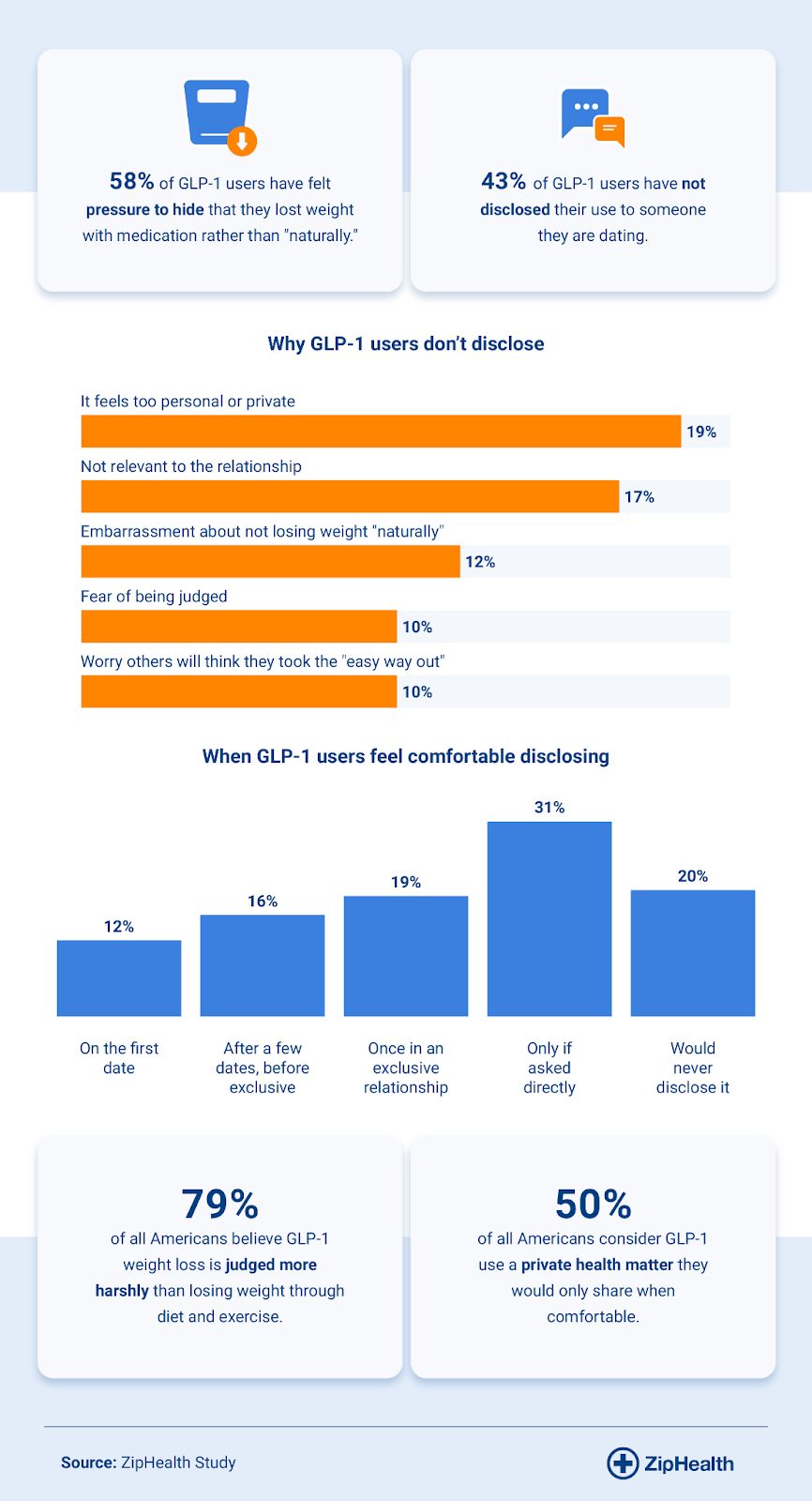
Half of all Americans consider GLP-1 use a private matter someone would share when they felt comfortable. Among GLP-1 users, 47% said they would disclose their usage once they became exclusive or before, including 12% who would do so on a first date. Most people see it the way they would any private health matter, as something worth sharing when the trust is there.
That said, the decision isn't always easy. Overall, 43% of GLP-1 users have not yet disclosed medication usage to someone they are dating. Their reasons are understandable:
- It feels too personal (19%).
- It's not relevant to the relationship yet (17%).
- They're worried about how a partner might react (10%).
Another 58% of GLP-1 users said they have felt some pressure to hide the fact that they lost weight with medication rather than through diet and exercise alone. Men who used GLP-1s were more likely than women to report feeling this pressure (68% vs. 53%). Body image anxiety is far from a one-gender experience, and the emotional weight of these decisions can affect anyone.
ZipHealth clinicians encourage patients to remember that choosing medical support for weight management is a valid, health-forward decision, not something that needs justification. If the pressure to hide feels heavy, that's worth bringing up with a healthcare provider who can help put it in perspective.
Many Americans (79%) said they believe GLP-1 weight loss is judged more harshly than losing weight through diet and exercise alone. But believing this stigma exists and actually experiencing it are two very different things. When faced with the real situation, most people seem not to mind.
How people actually react to GLP-1 use
When GLP-1 users do open up, the response is almost always better than they feared, and often much better.
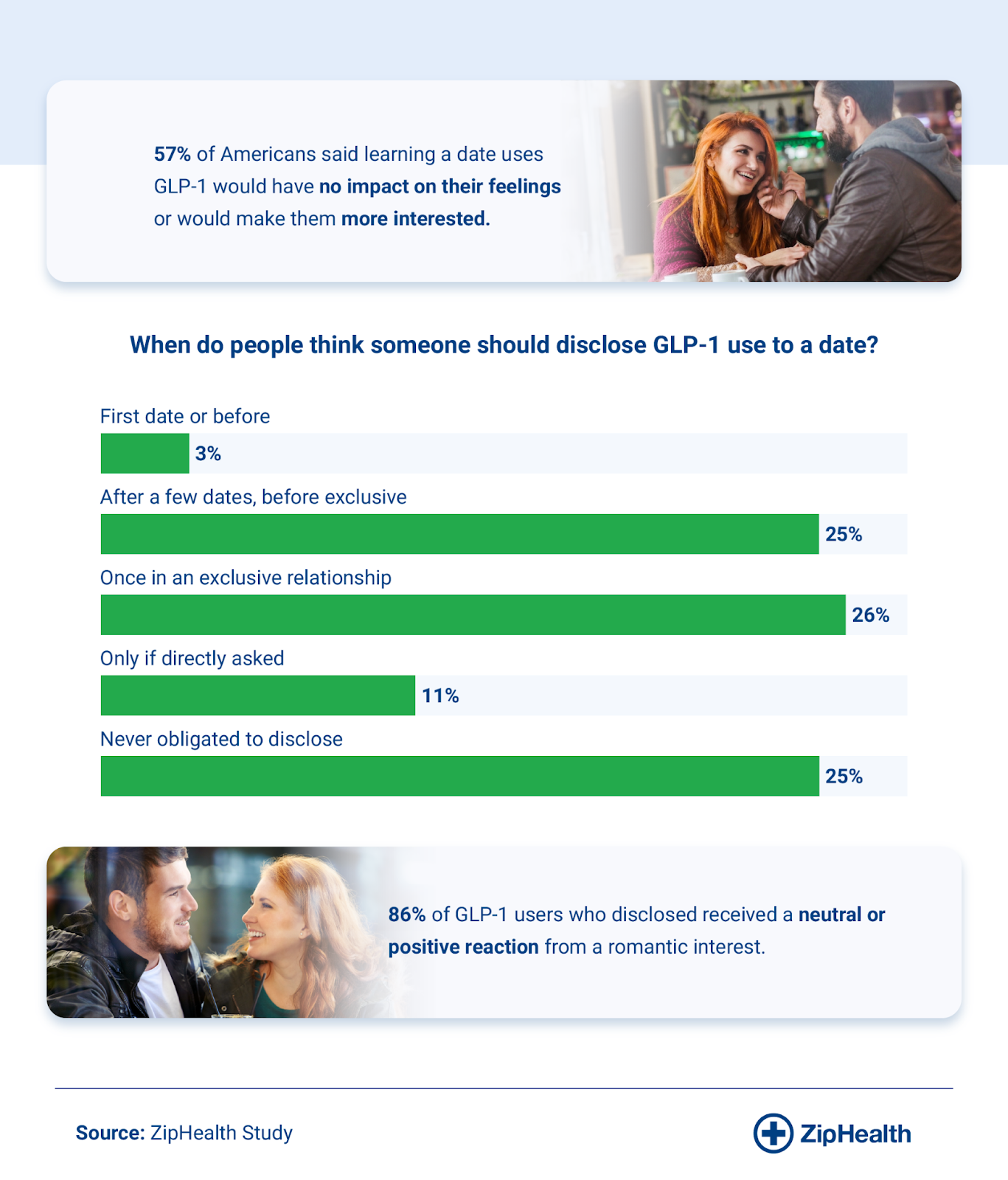
A majority of those who disclosed GLP-1 use (86%) received a neutral or positive reaction from a romantic interest. And zooming out to the broader public, 57% of Americans said learning that a date uses a GLP-1 medication would have no impact on their feelings, or would make them more interested. Only 18% said it would make them less interested.
"There's often a significant gap between the judgment people anticipate and the judgment they actually receive," says Dr. Zoë Lees (PhD), Medical Writer at ZipHealth. "Our data shows that most partners are far more accepting than GLP-1 users expect."
Dr. Zoë suggests that "When you're ready to share, lead with honesty and keep it simple. You made a decision to support your health, and that's something to feel good about. If a partner reacts negatively, that tells you more about their values than about your choice. And if the anxiety around disclosure is affecting your relationships or your sense of self, a clinician can help you work through that in a way that supports both your emotional and physical wellbeing."
More than half of Americans (51%) believe disclosure should wait until after a few dates or once in an exclusive relationship, and 25% believe GLP-1 users are never obligated to disclose their medication use to someone they are dating. This is personal health information, and you get to decide when and whether to share it.
The confidence payoff
Whatever the disclosure journey looks like, what GLP-1 users are experiencing on the other side of it is worth celebrating.
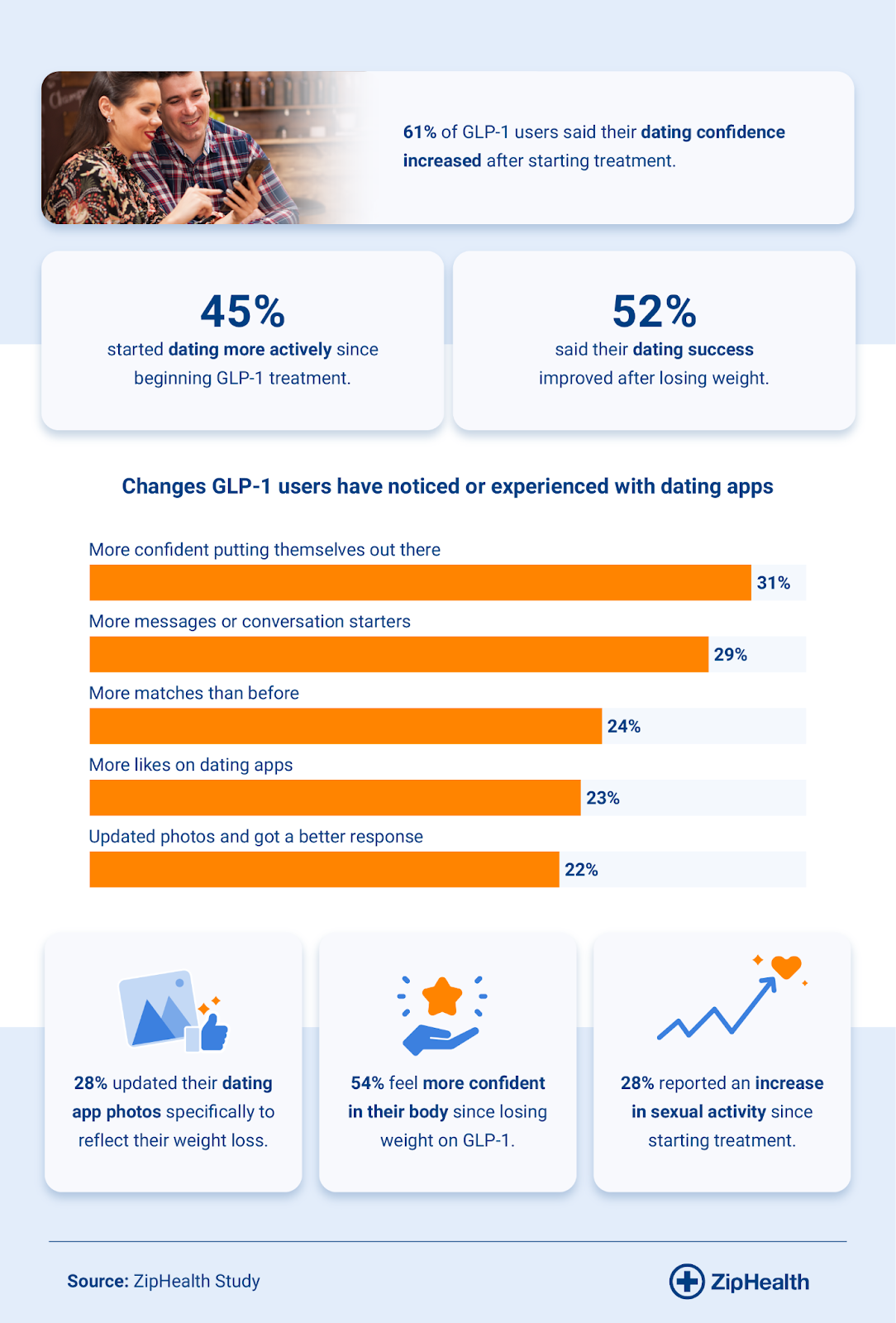
Among GLP-1 users, 61% said their dating confidence increased after starting treatment, including 18% who said it increased significantly. Singles on GLP-1 medications reported going on 60% more dates per month after starting treatment, averaging 1.6 dates per month compared to 1.0 before. Nearly half (45%) started dating more actively, including 15% who returned to dating after stepping away entirely.
The positive effects are also showing up on dating apps:
- 31% feel more confident initiating contact with a match.
- 29% are getting more messages.
- 24% are getting more matches.
Of GLP-1 users, 28% updated their profile photos specifically to reflect their weight loss, with men doing so at more than three times the rate of women (50% vs. 15%).
Beyond the apps, 54% feel more confident in their body, 44% feel more comfortable in social situations, and 41% feel more attractive. More than half (52%) of GLP-1 users said their dating success has improved, and 28% report an increase in sexual activity since starting treatment, a reflection of how physical confidence and intimate connection tend to move together.
Understanding your options
Weight loss is personal, and so is the decision to get support. What this research shows is that when people feel better in their bodies, it often carries over into how they date, connect, and experience intimacy. For those figuring out what the next step looks like, having access to the right kind of care can make that decision feel less overwhelming. ZipHealth gives people a way to explore their options with guidance from licensed providers, so they can move forward in a way that feels informed, private, and right for them.
Methodology
ZipHealth surveyed 1,000 single Americans in March 2026. Of all respondents, 5.1% are currently using a GLP-1 medication, and 4.2% have used one in the past, for a combined 9.3% with firsthand GLP-1 experience. Respondents were 50.9% women, 46.2% men, and 2.6% non-binary. Generationally, 48.2% were millennials, 34.2% were Gen Z, and 14.9% were Gen X.
About ZipHealth
ZipHealth offers clinician-led consultations and treatments to support your health goals, including Compounded* Liraglutide, a daily injectable GLP-1 medication formulated with vitamin B12. It contains the same active ingredient found in brand-name medication, with no insurance required and fast, discreet delivery. Start your quick online consultation today.
*Compounded medications are not FDA-approved and are prescribed when appropriate based on individual clinical assessment. GLP-1 medications are prescription treatments indicated for specific medical conditions and require clinical oversight.
Fair use statement
This study may be shared for noncommercial purposes with attribution and a link back to ZipHealth. If quoting or referencing this research, please include credit to ZipHealth.