The STI Anxiety Index: What Americans and Canadians Are Most Afraid to Catch
New ZipHealth data shows which STIs Americans and Canadians fear most, and how that worry splits from where infections are actually rising.


The infections people fear most aren't always the ones spreading fastest. To see how wide that gap runs, ZipHealth mined 24 months of DataSEO and Google search data across the United States and Canada, ranking public worry about six common STIs: HIV, herpes, gonorrhea, chlamydia, syphilis, and HPV. Setting that search-driven fear against reported case data from the CDC and PHAC exposed a clear disconnect between what worries people and what's actually climbing.
That anxiety follows geography, the calendar, and the questions people type when they're scared. The findings below show where STI fear runs highest, where it drifts from the real numbers, and when it spikes throughout the year.
Key takeaways
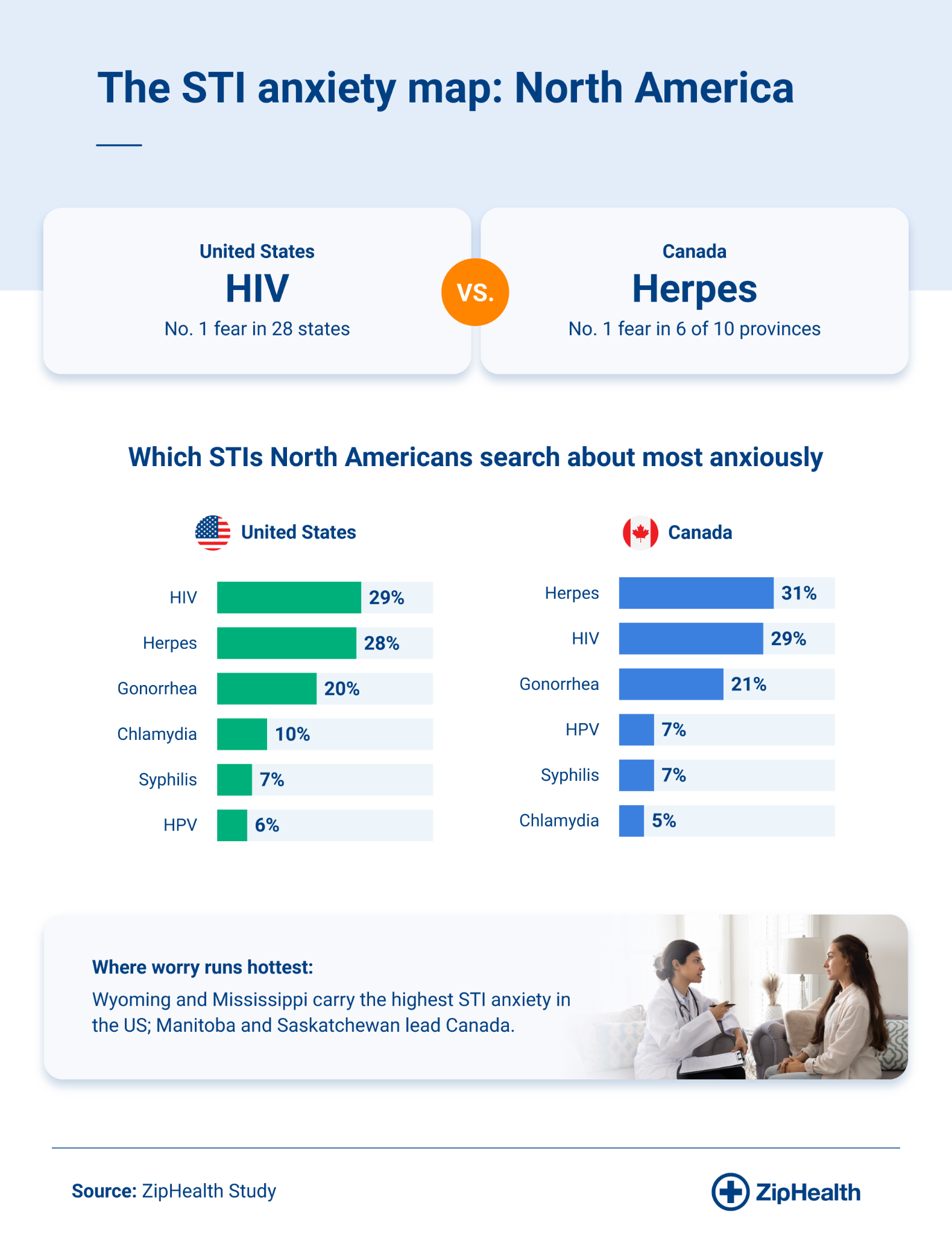
- HIV is the No. 1 STI Americans worry about, drawing 29% of all STI anxiety searches.
- Herpes is the No. 1 STI Canadians worry about, topping the national index at 31%.
- In the past decade, syphilis cases jumped 165% in the US and 421% in Canada, yet it ranks near the bottom of search fear.
- Chlamydia is America's most common STI, with 1.6 million cases, but it ranks only fourth in anxiety.
- Herpes drives 36% of all "is it curable" searches, the infection people most fear is permanent.
- In the United States, STI anxiety peaks at 11% above average in September and bottoms at 16% below in February.
- In Canada, STI anxiety peaks at 10% above average in May and bottoms at 10% below in February.
Where STI fear runs highest across the map
Search anxiety clusters in specific states and provinces, and the infection people fear most shifts as you move across the map.
US STI searches
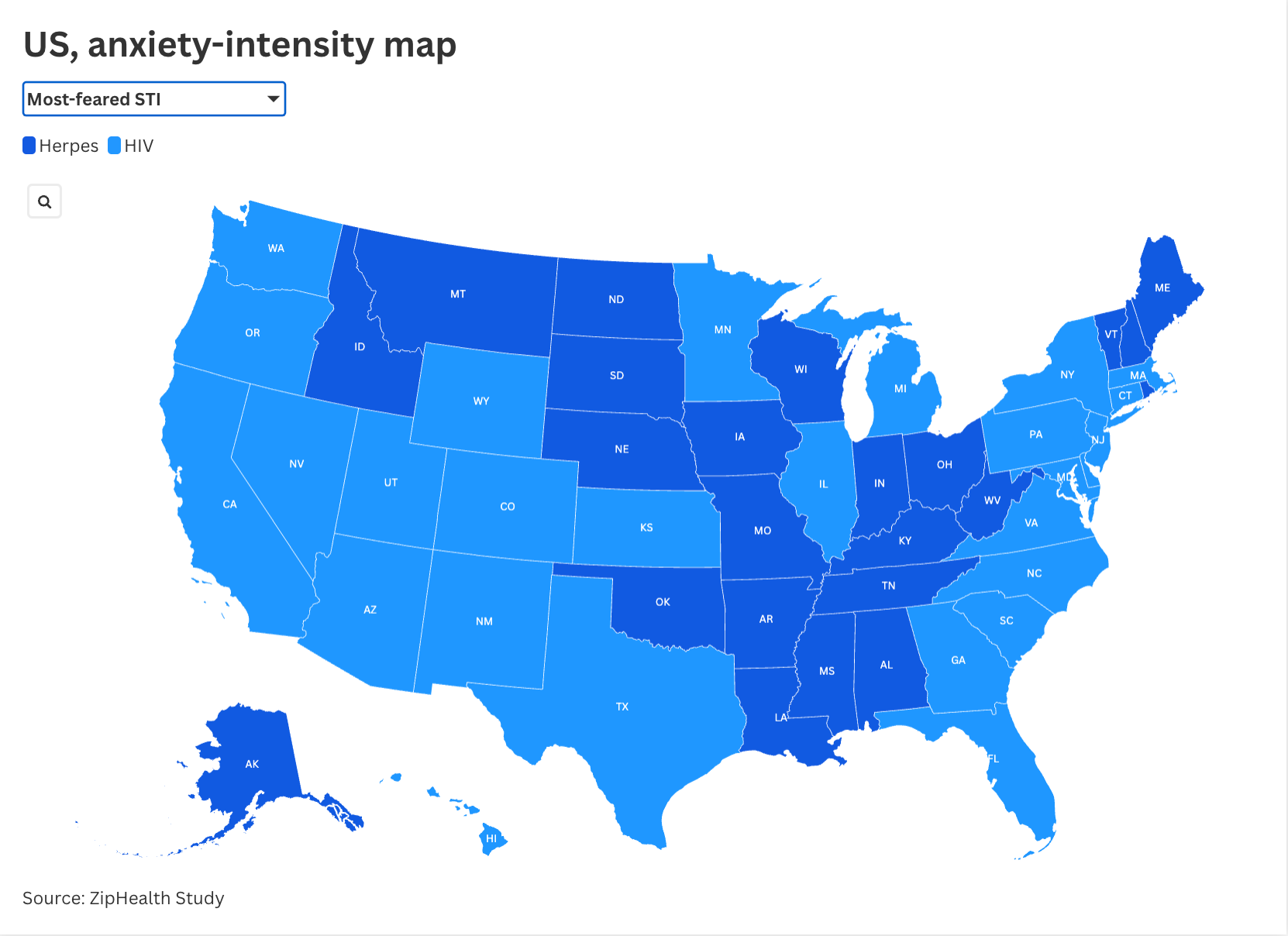
In the US, HIV and herpes dominated the worry, together making up 57% of all STI search anxiety. HIV led the country at 29%, while a herpes belt stretched across 23 states through the South, Appalachia, and the rural Plains, from Mississippi and Kentucky up to the Dakotas.
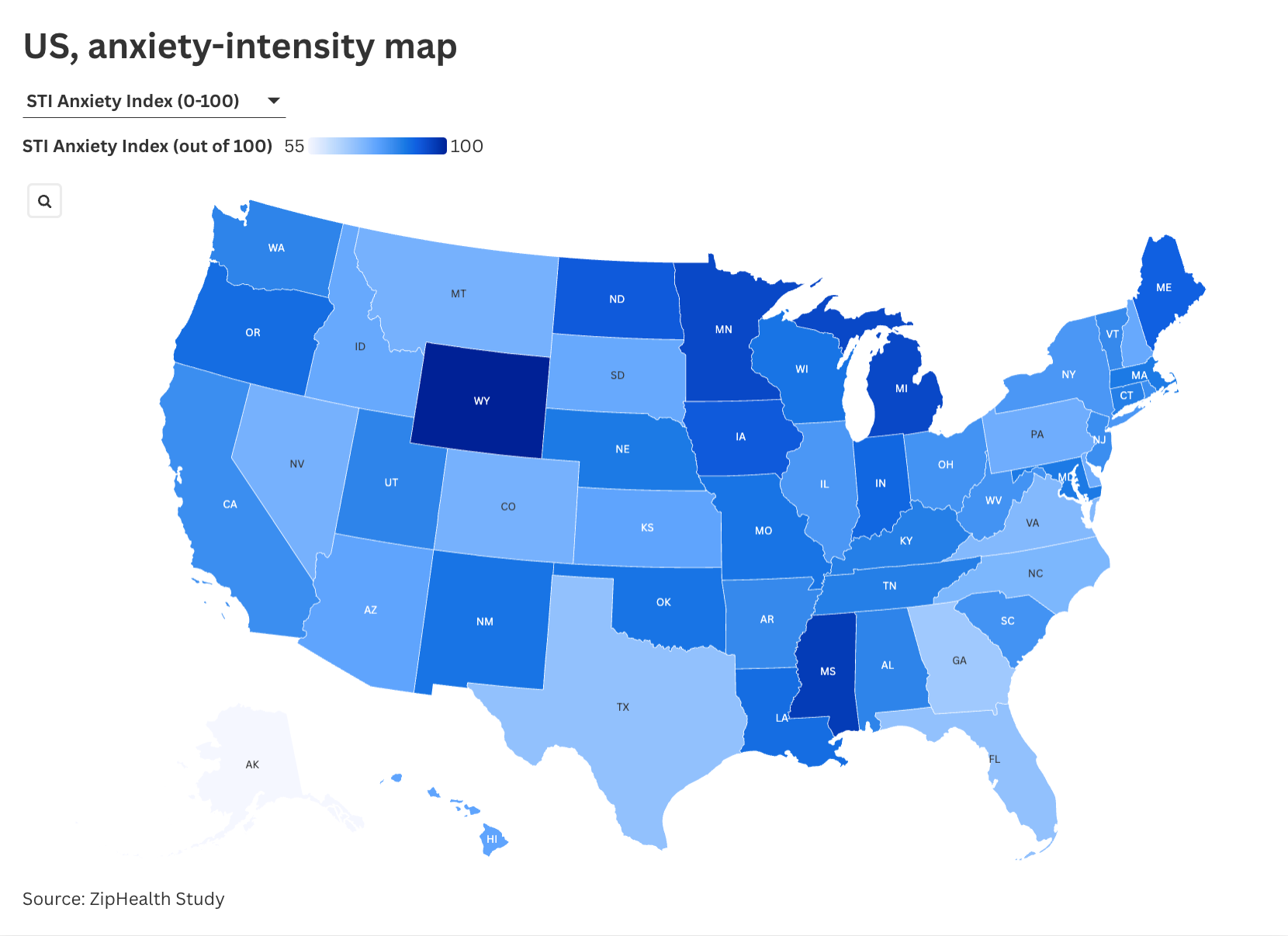
Wyoming carried the highest STI anxiety of all 50 states and DC, ahead of Mississippi and Minnesota. Fear didn't track caseloads, though. Three of the five lowest-anxiety states were Florida, Georgia, and Texas, even though their case counts run high.
Canada STI searches
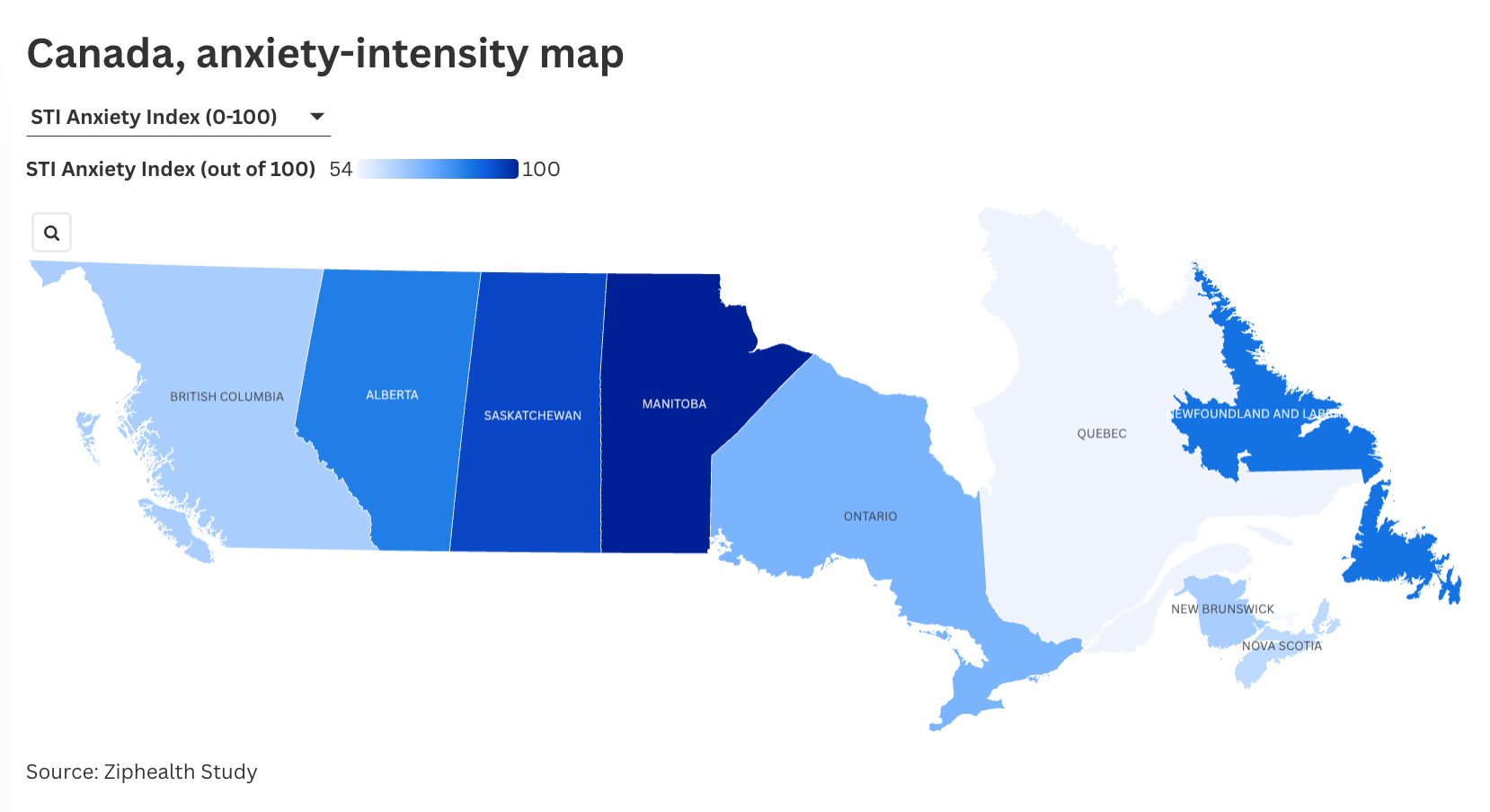
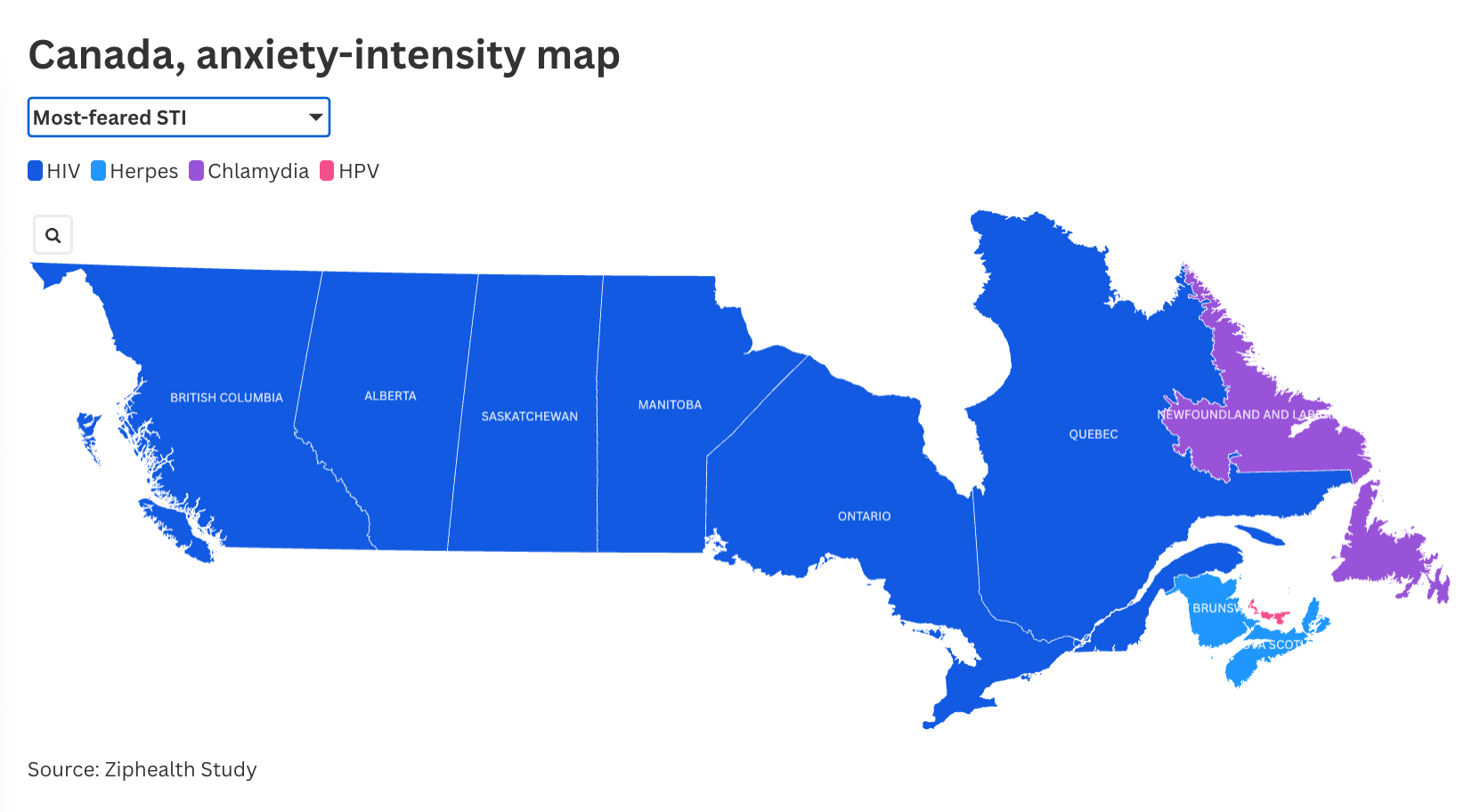
North of the border, herpes topped the national index at 31%, yet HIV was the most-feared STI in six of Canada's 10 provinces. The three Prairie provinces posted the country's highest anxiety, led by Manitoba (100) and Saskatchewan (94), while Québec recorded the lowest score among Canada's four largest provinces (55).
Only two provinces, New Brunswick and Nova Scotia, ranked herpes above HIV. Newfoundland was the one province where chlamydia led, and Prince Edward Island was the only one where HPV did. Gonorrhea was the single point of agreement across the border, ranking third in both countries at 20% in the US and 21% in Canada.
When fear and infection rates don't line up
The STIs that dominate people's searches often aren't the ones climbing fastest in the case data.
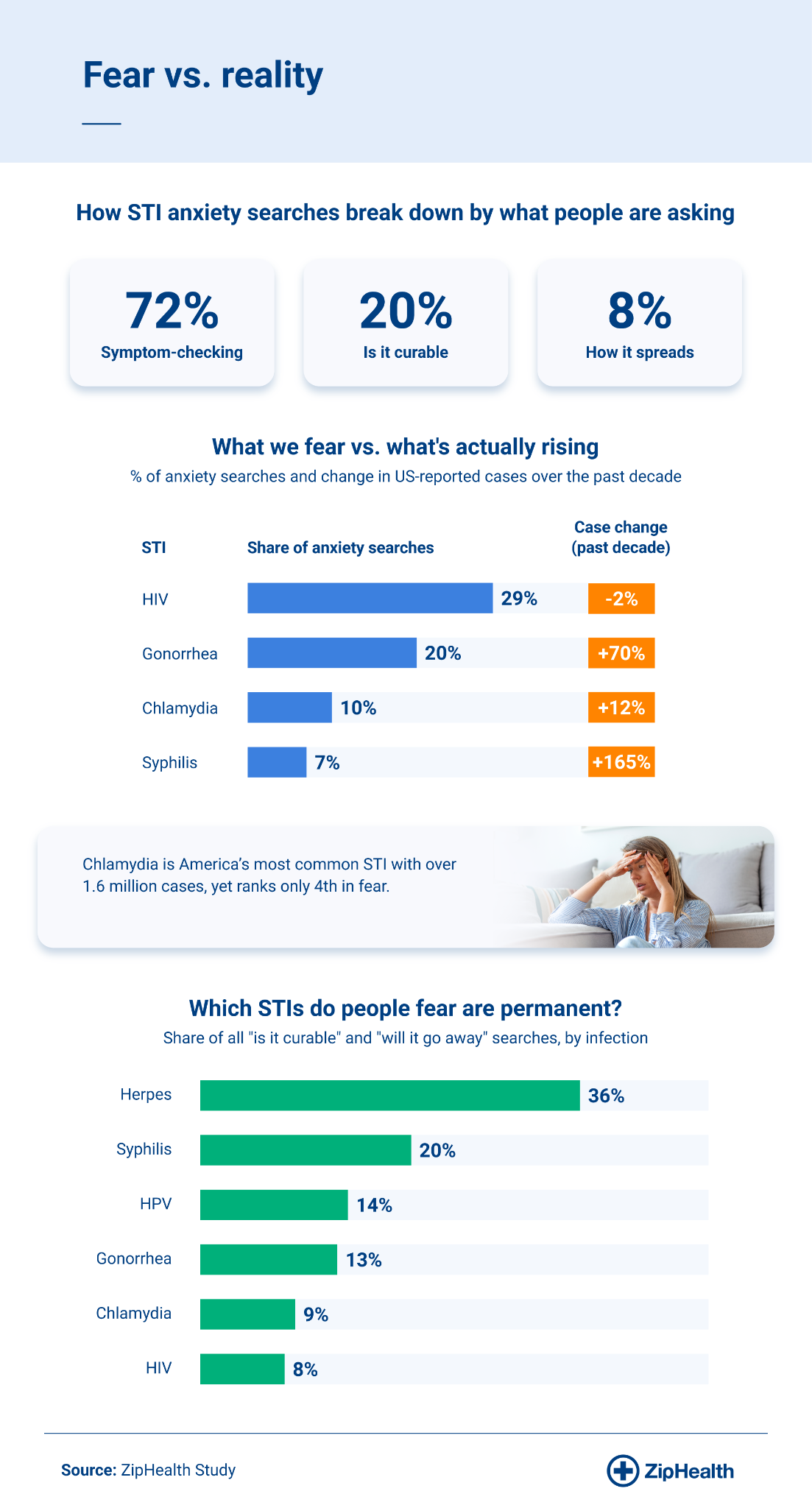
Most STI searches came from a place of immediate worry. Symptom checks accounted for 72% of STI anxiety searches. Another 20% asked whether an infection is curable, and just 8% asked how it spreads. People were reacting to something they were already feeling rather than researching prevention.
That worry didn't follow the case numbers. HIV cases fell 2% over the past decade, yet it stayed America's top STI worry at 29%. Syphilis showed the opposite pattern. Cases climbed 165% in the US and 421% in Canada over the same period, but fear stayed low, at just 7% in both countries. Chlamydia was the most commonly reported STI in the US at 1.6 million cases, yet it ranked only fourth in anxiety.
The fear also concentrated around specific questions. Herpes drove 36% of all "is it curable" searches, making it the infection people were most worried was permanent, while HIV was the least feared on that count at 8%.
HIV instead drove disclosure anxiety, drawing nearly four times as many "how to tell my partner" searches as herpes, the only other STI with measurable disclosure fear. Much of that worry centers on stigma and permanence, questions that a quick, confidential consultation can often answer faster than a late-night search can.
How STI worry rises, falls, and shifts over time
STI anxiety isn't steady. It swells and fades with the calendar and has moved sharply in a few regions over the past two years.
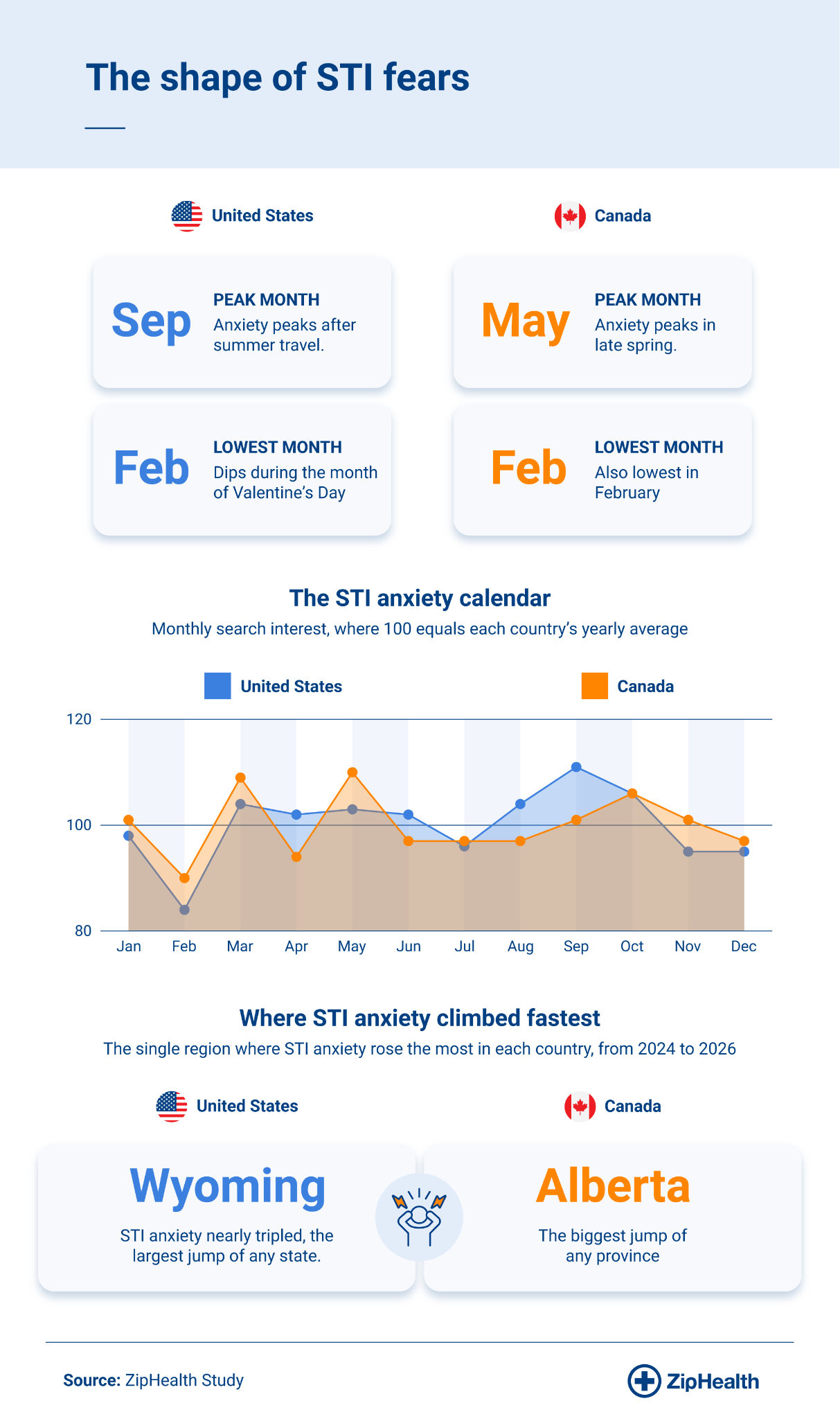
In the US, STI anxiety peaked 11% above average in September and bottomed out 16% below average in February. Canada followed a similar late-winter low, dipping 10% below average in February, then climbing to its yearly high in May at 10% above average.
A few regions have swung hard. Wyoming's STI anxiety rose 182% over two years, nearly tripling and leading every state, with Vermont posting the next-biggest US jump at 47%. Alaska moved the other way, falling 60%. In Canada, Alberta edged up 7% to lead the country, while Newfoundland dropped 42%, the steepest decline of any region in either country.
What the fear map means for your health
Across every map and chart, the same pattern holds. Fear and risk don't always match, and syphilis has been climbing quietly while the infections people search about most are holding steady or falling.
If a symptom or an uncertain result is weighing on you, a real answer usually beats another late-night search. That's where ZipHealth fits in, with quick, discreet online consultations and US-based clinicians who can guide testing and treatment from home whenever the worry hits.
Methodology
The STI Anxiety Index uses search behavior as a proxy for public worry about six STIs: HIV, herpes, gonorrhea, chlamydia, syphilis, and HPV. It draws on absolute monthly search volume from DataForSEO (the Index ranking and seasonality calendar), Google Trends relative interest (the fear maps, biggest movers, and disclosure findings), and CDC and PHAC-reported case data, used only as a real-world benchmark. Search data spans 2024 to 2026; case data runs through 2023, the latest complete year.
The Index was built from a curated keyword set that applied the same query types (symptoms, curability, transmission) to each infection. Because the source returns identical volume across spellings of the same query, we counted each concept once per infection, so heavily misspelled terms like gonorrhea were not inflated. Each infection's share is its volume as a percentage of the country's total.
The United States and Canada were normalized separately and are compared only on ranks and within-country shares, never on absolute values. On the maps, each region's color indicates its most-feared STI, and the shading reflects that region's total anxiety, scaled within its own country. The biggest-mover analysis compares each region's first-half and second-half interest, within each country only.
The fear-versus-reality comparison compares each STI's search rank with its reported cases and the change from 2014 to 2023. Only chlamydia, gonorrhea, syphilis, and HIV appear, since herpes and HPV are not notifiable and have no case data.
Limitations: search interest reflects attention, not infection rates; U.S. 2024 case data is incomplete, so trends end in 2023; disclosure and blame searches are too sparse for four of the six STIs, so we report them as findings rather than forcing a ranking. All percentages are rounded to the nearest whole number.
About ZipHealth
ZipHealth provides easy, discreet access to online health consultations and treatments, backed by US-based, US-registered clinicians. From a quick online consultation, you can get prescription treatment like Valtrex shipped to your door in discreet packaging, with no in-person visit required. Our goal is to make healthcare more accessible, so you can manage sensitive health concerns comfortably and privately from home.
Fair Use Statement
You're welcome to share the findings from the STI Anxiety Index for any noncommercial purpose. We only ask that you link back to this page so readers can see the full study and that ZipHealth receives proper credit.