The Age-Gap Performance Anxiety Report
Nearly half of men feel more sexual anxiety with an older partner. A ZipHealth survey of 747 men reveals the age-gap performance gap.


In pop culture, being with an older woman is sold as an easy, flattering fantasy. For a lot of men, the private reality comes with a knot of nerves they almost never admit to.
ZipHealth surveyed 747 men who had been intimate with a partner at least five years older, and many described feeling more anxious and more scrutinized than they did with someone their own age. The responses point to age-gap performance anxiety that unfolds almost entirely in private.
Key takeaways
- Nearly half of men (47%) feel more sexually anxious with an older partner than with someone their own age.
- A 10-year age gap is the most common breaking point, with 42% of men feeling intimidated once a partner is at least a decade older.
- The fantasy has a flip side, as 27% say the very thing that draws them to an older woman is also what makes them nervous.
- 35% of men thought an older partner was judging their performance, but only 4% saw real proof of it.
- Most keep it hidden, with 77% of men never telling anyone about their age-gap performance anxiety.
- 1 in 7 men (14%) have sworn off older partners, or considered it, after a single bad experience.
The older woman effect
The pull toward an older partner and the nerves that come with it tend to show up together.
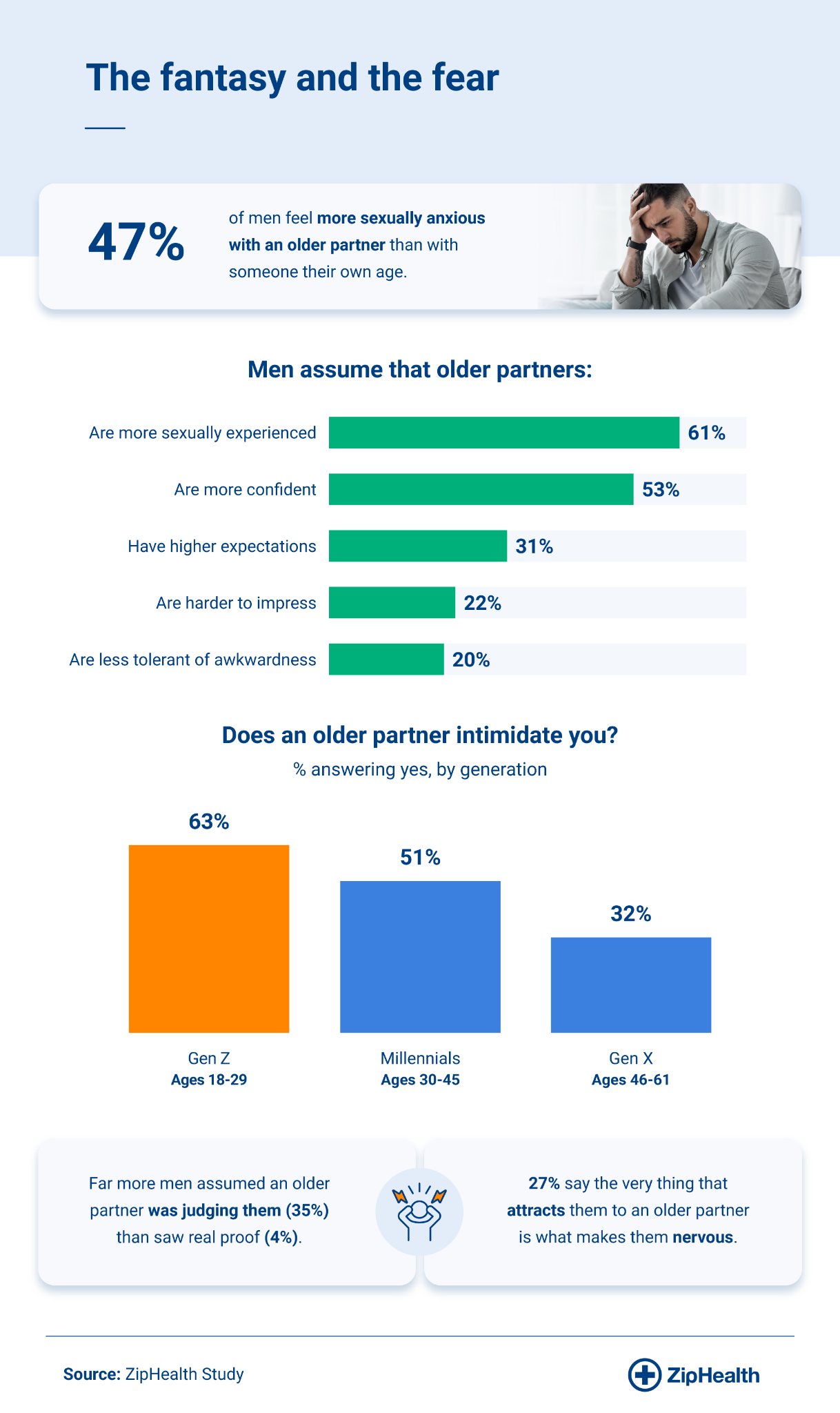
Our data showed how often older-partner fantasies come with a knot of nerves:
- Nearly half of men (47%) feel more sexually anxious with an older partner than with someone their own age, and 11% feel it often or always.
The age gap where intimidation begins
- A 10-year gap is the most common breaking point, with 42% feeling intimidated once a partner is at least a decade older.
- Younger men reach that point sooner, with intimidation kicking in around a 9-year gap for Gen Z vs. 13 years for Gen X.
- Gen Z men are the hardest to reassure, as just 31% say no age gap intimidates them, compared with 52% of Gen X.
What men assume about an older partner
- Before anything happens, men assume an older partner is more sexually experienced (61%) and more confident (53%) than they are.
- Men who only assumed an older partner was judging them (35%) outnumbered those who saw clear evidence (4%).
When nerves affect performance
- Worry turned physical for some, as 22% say fixating on an older partner's expectations actively hurt their arousal or confidence in the moment.
- More than a quarter (27%) say the very thing that drew them to an older partner is also what makes them nervous about measuring up.
Performing under pressure
Being with an older partner can turn ordinary nerves into real performance pressure, and that pressure is closely tied to the kind of situational ED that clinicians see often.
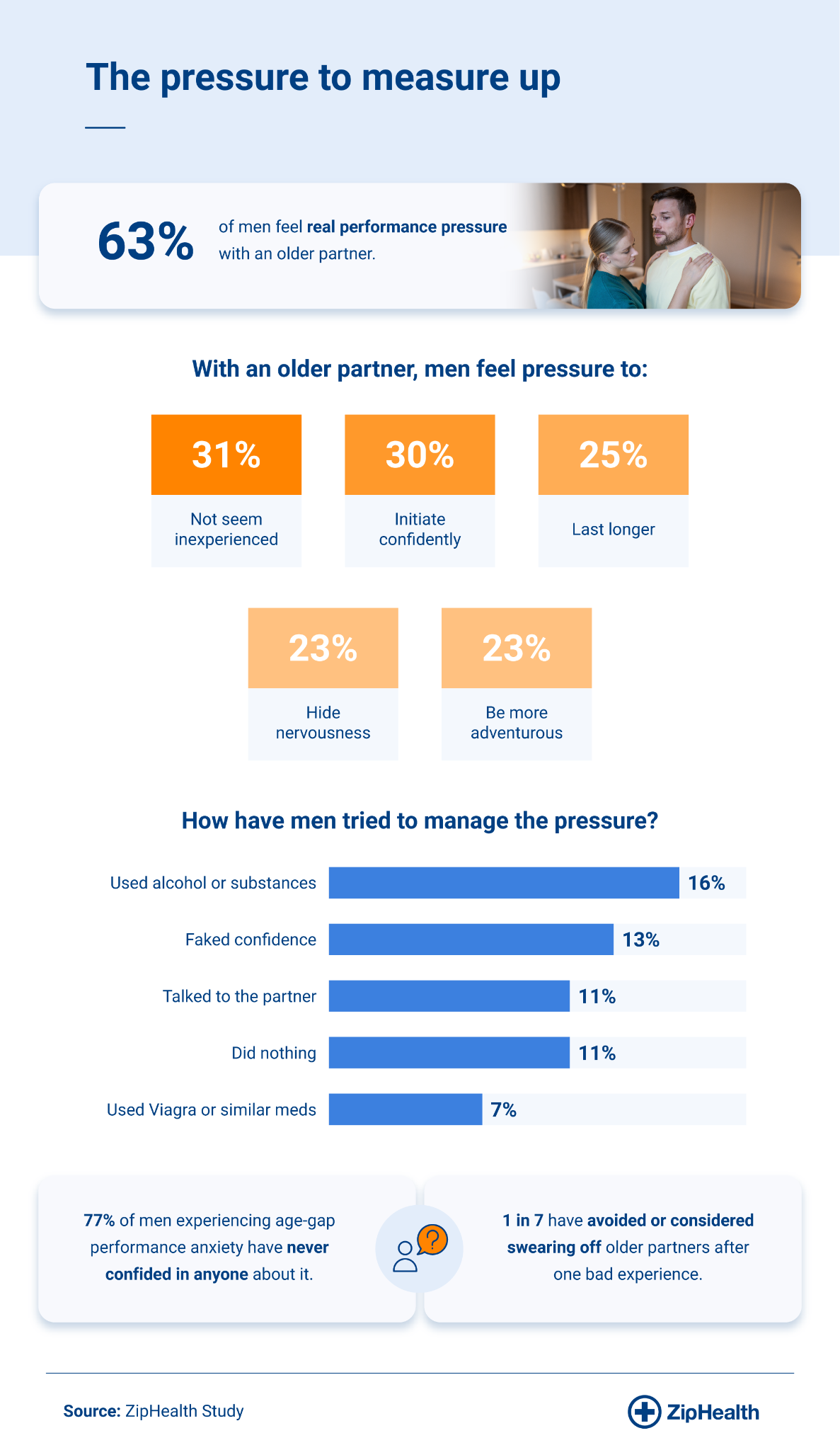
How widespread is performance pressure with an older partner?
- 63% of men feel performance pressure with an older partner, rising to 83% among Gen Z.
- The top pressure is avoiding the appearance of inexperience, cited by 31% of men.
- Older partners were the biggest trigger for performance anxiety, named by 19% of men, more than twice the share who felt it most with a same-age (9%) or younger (8%) partner
How men cope with the pressure
- When men attempted to cope, they most often reached for alcohol or other substances (16%), followed by faking confidence (13%).
- A bad experience could end things, with 8% swearing off older partners entirely, and another 5% considering it.
Why most men suffer in silence
- Silence is the norm, as 77% keep the performance anxiety entirely to themselves. Only 7% have ever spoken to a doctor or therapist about it.
Turning private anxiety into an open conversation
The clearest takeaway is how much men carry on their own. Most of the anxiety here stayed private, even though performance worries and ED-like symptoms are common and treatable. A short conversation with a clinician is often the fastest way to separate ordinary nerves from something worth treating. That's the gap ZipHealth is built to close, with US-based clinicians and discreet online ED treatment that skips the in-person visit. Age gap or not, a real answer beats guessing.
Methodology
ZipHealth surveyed 747 men about their experiences and feelings with partners older than themselves. To qualify, respondents had to be men who were sexually active and had had at least one sexual relationship or encounter with a partner five or more years older; anyone who did not meet this screen was disqualified. The survey was fielded in June 2026 via CloudResearch Connect, and every response carried a unique participant ID, with duplicate or incomplete records removed before analysis.
Respondents spanned four generations, defined by age as Gen Z (18 to 29), millennials (30 to 45), Gen X (46 to 61), and baby boomers and older (62+). The final sample skewed millennial (53%), followed by Gen X (26%), Gen Z (15%), and baby boomers and older (6%).
For questions where respondents could choose more than one answer, percentages reflect the share of all respondents who selected each option, so totals can exceed 100%. For open numeric questions, such as the age gap at which intimidation begins, we report averages after removing statistical outliers using the interquartile range (IQR) method to prevent extreme values from distorting the results. All figures are rounded to the nearest whole number, so some totals may not sum to exactly 100, and combined figures may differ slightly from the sum of their rounded parts.%.
All performance-related findings are self-reported and reflect respondents' own perceptions rather than clinical measurement or diagnosis. Language throughout describes "performance issues or ED-like symptoms" and does not represent medically confirmed rates. Demographic breakdowns are reported only for subgroups representing at least 5% of the total sample; smaller segments were reviewed but are considered directional. Because this was a self-selected online panel, results describe the men surveyed and are not projected to represent all men.
About ZipHealth
ZipHealth provides easy, discreet access to online health consultations and treatments, from ED medications like Cialis and tadalafil to care for other everyday conditions. Backed by US-based clinicians, ZipHealth makes getting the right treatment simple, private, and fast, without an in-person appointment.
Fair use statement
You're welcome to share the findings and visuals from this study for noncommercial purposes. We just ask that you link back to this page so readers can see the full research and the team behind it gets proper credit.