Would You Sleep With A Robot? AI, Intimacy, And The Future Of Sexual Companionship
Romantic AI is already here. See what ZipHealth found about chatbot intimacy, loneliness, and loyalty in modern dating.


AI is starting to blur the line between tool and companion. A lot of people are not just noticing that shift, but imagining what it could mean for dating, sex, and emotional support. To explore this new phenomenon, ZipHealth surveyed over 1,000 Americans and Canadians about romantic AI interactions and how AI companionship could affect real-world relationships and sexual health.
As AI reshapes how people experience connection, experts are beginning to question what this means for real-world intimacy, sexual confidence, and long-term relationship health.
Key takeaways
- More than 1 in 2 people (55%) say talking to an AI feels easier than talking to a real person.
- Nearly 1 in 4 people (23%) would consider being physically intimate with a lifelike humanoid robot.
- Nearly 1 in 5 people (19%) have already engaged in romantic or sexual AI interactions, and 1 in 2 of those adults (50%) kept it a secret from their partner.
- More than 1 in 4 Gen Z adults (26%) have already engaged in romantic or sexual interactions with AI.
- 7 in 10 people consider developing romantic feelings for an AI to be cheating.
AI intimacy already feels real for many people
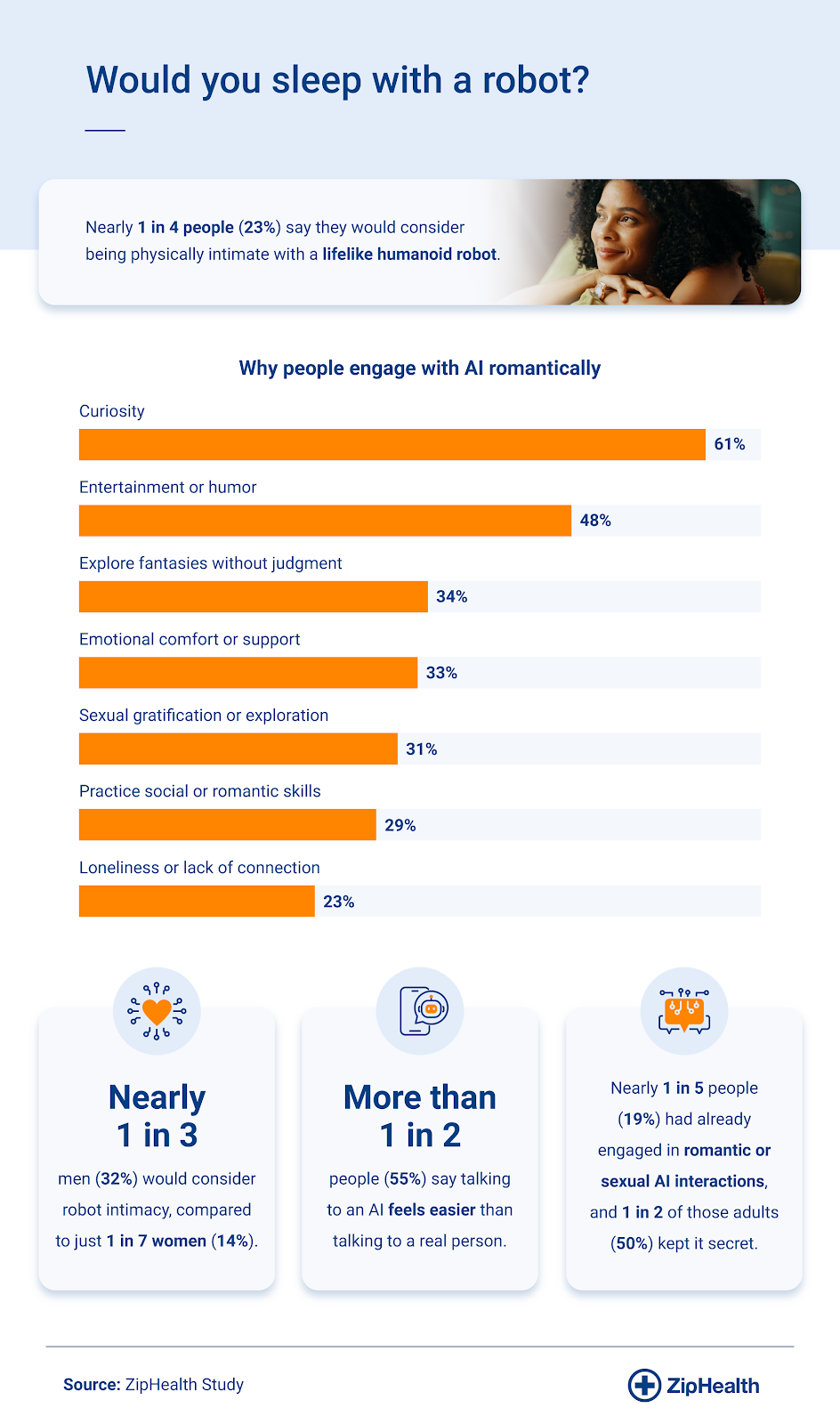
Openness to robot intimacy
- 27% of daily AI users would consider intimacy with a lifelike humanoid robot, nearly double the rate of those who rarely use AI (14%).
- Single people (28%) are more open to robot intimacy than married (22%) or partnered (20%) respondents.
- Among women open to romantic AI, 29% state loneliness as a motivator, compared to 19% of men.
AI use for emotional support
- 37% of people in a relationship have used AI for emotional support, significantly higher than those who are single (26%) or married (23%).
- 34% of women have used an AI chatbot for emotional support or companionship, compared to 22% of men.
- Gen Z leads in using AI for emotional support (36%), followed by millennials (26%) and Gen X (24%).
Romantic or sexual AI interactions
- 26% of Gen Z adults have engaged in romantic or sexual interactions with AI, compared to 19% of millennials and 14% of Gen X.
- Men are more likely than women to engage in these interactions (23% vs. 16%).
- 27% of daily AI users have engaged in romantic or sexual AI interactions, over 3 times the rate of monthly users (8%).
- Among those who have engaged, 19% told a supportive partner; 5% said their partner was uncomfortable, and 5% reported serious conflict.
People draw firm boundaries around AI and cheating
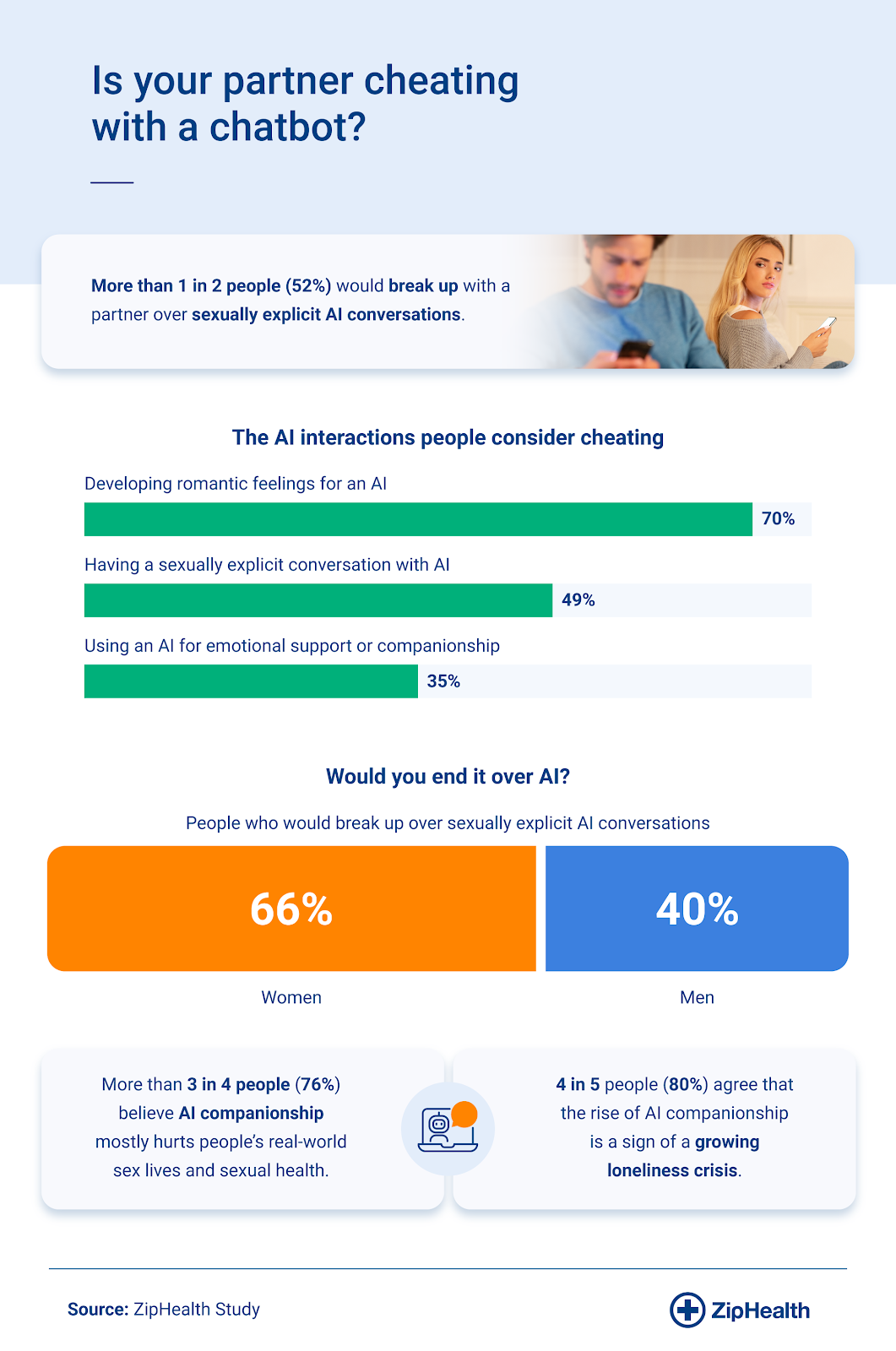
A growing loneliness crisis
- Gen Z adults (26%) report the highest rate of romantic AI engagement. At the same time, 83% say it signals a growing loneliness crisis.
- 86% of Canadians agree AI companionship signals a loneliness crisis, compared to 75% of Americans.
Trust and cheating in an AI world
- Gen X (39%) is the most likely generation to trust an AI companion to be more loyal than a human partner, compared to millennials (29%) and Gen Z (27%).
- 76% of Canadians consider developing romantic feelings for AI to be cheating, compared to 63% of Americans.
- 73% of monthly AI users view developing feelings for AI as cheating, versus 64% of daily users.
- 56% of women say they would break up over flirtatious or romantic AI conversations, compared to 32% of men.
Will AI help or hurt?
- 75% of Canadians believe AI intimacy will make relationships worse, compared to 65% of Americans.
- 79% of women and 72% of men say AI companionship mostly harms people's real-world sex lives and sexual health.
- 38% of men believe AI companionship could improve real-world relationships, compared to 28% of women.
- 9% of men say AI could replace a real romantic relationship, compared to 6% of women. Gen X and millennials (9% each) are the most open to this idea, versus just 2% of Gen Z.
Intimacy, loneliness, and the next relationship gray area
AI companionship is already fulfilling emotional needs for some people, while raising red flags for others. Younger adults and frequent AI users are often the most engaged, yet many still see romantic attachment to AI as cheating and a sign of deeper loneliness.
That tension points to something bigger. As AI becomes more personal, people will continue redefining what counts as connection, loyalty, and intimacy. While AI companionship may offer a low-pressure alternative to dating, it removes the unpredictability and vulnerability that help build real-life intimacy. For some, this could mask deeper concerns around sexual confidence or performance, issues that are common, treatable, and worth addressing with a healthcare professional. The technology may be new, but the questions it raises about closeness and trust are deeply human.
Methodology
We surveyed 1,013 Americans and Canadians to explore attitudes toward AI-powered intimacy, companionship, and its impact on real-world relationships and sexual health. Among the 502 Americans, the average age was 40; 53% were male, 46% were female, and 1% were non-binary.
Generationally, 5% were baby boomers, 24% were Gen X, 55% were millennials, and 17% were Gen Z. Among the 498 Canadians, the average age was 36; 49% were male, 49% were female, and 2% were non-binary. Generationally, 4% were baby boomers, 15% were Gen X, 48% were millennials, and 34% were Gen Z.
About ZipHealth
ZipHealth offers discreet online consultations and treatments for a range of conditions for those eligible, including medications like Viagra and Sildenafil, so you can manage your health conveniently and privately.
Fair use statement
This report may be shared for noncommercial purposes with attribution and a link back to ZipHealth. If quoting or referencing this study, please include credit to ZipHealth.