The Sex Menu Surge: How Couples Are Rewriting The Rules Of Intimacy
ZipHealth explores the rise of sex menus and how couples use them to improve communication, confidence, and intimacy.


Talking openly about intimacy is getting a lot less taboo, and more couples appear ready to make those conversations even clearer. ZipHealth's survey of 1,008 adults in relationships across the US and Canada looked at how people discussed sexual preferences, whether they had created a "sex menu," and what happened when they did.
For readers who care about communication, consent, and feeling more comfortable in their relationships, the findings point to a simple idea: putting preferences into words may take some of the guesswork out of intimacy.
Key takeaways
- More than 9 in 10 people in relationships (92%) agree that openly discussing boundaries improves intimacy.
- Nearly 1 in 10 people in relationships (7%) have created a sex menu with a partner.
- More than 1 in 2 people in relationships (54%) would be interested in creating a sex menu.
- 51% of couples who have tried a sex menu said the frequency of sex or physical intimacy in their relationship increased after creating one.
- Couples who have tried a sex menu were more likely than those who haven't to say open conversations about sexual preferences increased their sexual confidence (84% vs. 57%).
Interest in sex menus is growing
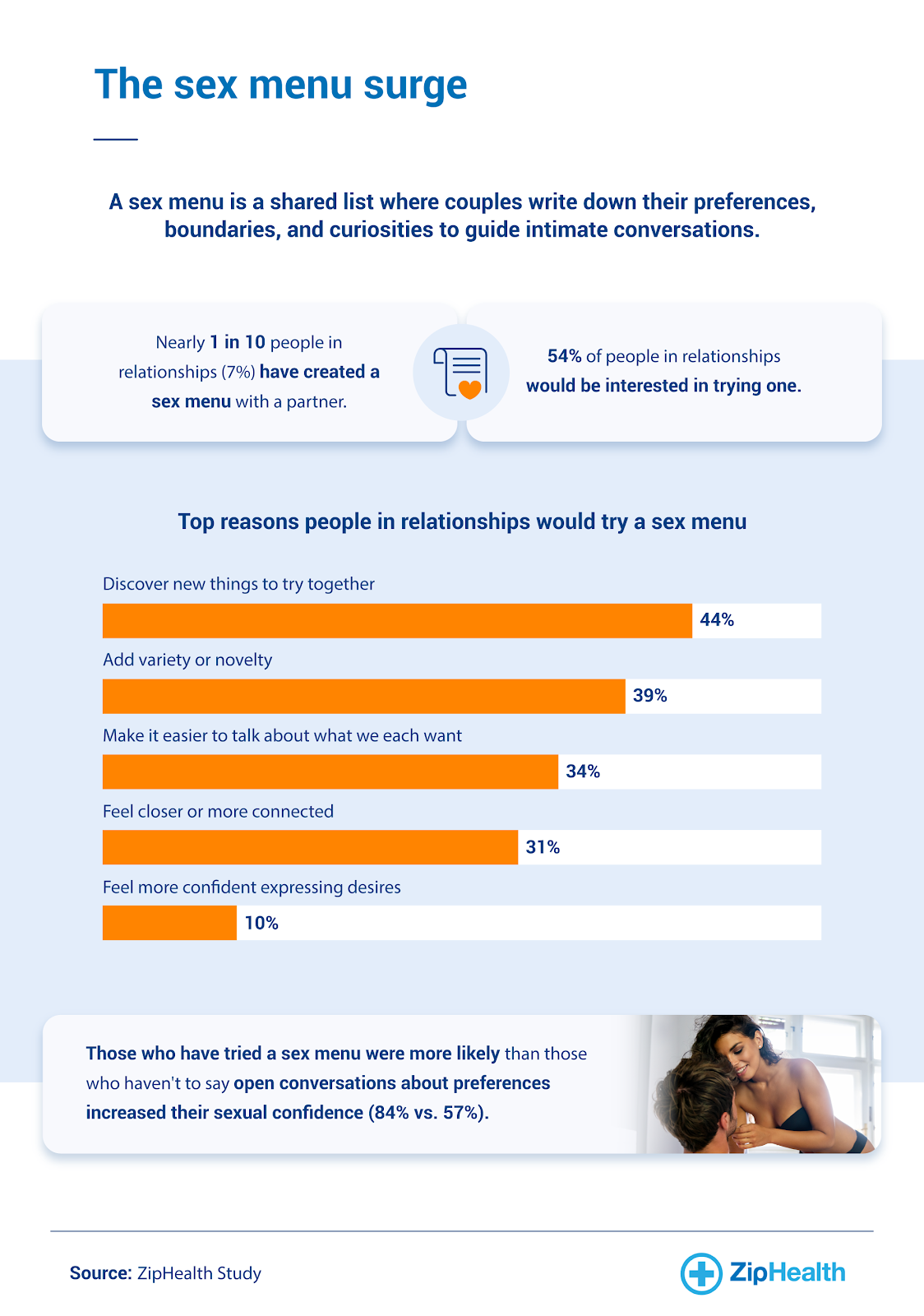
- About 3 in 5 people in relationships (59%) had never heard of a "sex menu."
- 68% of people in relationships first discussed sexual preferences within the first 3 months of a relationship or earlier, including 23% who said the conversation happened before they were in a committed relationship.
- Among people in relationships who had not created a sex menu, the most common barrier was simply not knowing people did it (42%), with women significantly more likely than men to cite this as a reason (47% vs. 34%).
- Gen Z respondents reported the highest rates of increased sexual confidence from openly discussing preferences (75%), compared to millennials (59%), Gen X (55%), and baby boomers (43%).
- Nearly 3 in 4 people in relationships (73%) communicate about sexual preferences through casual verbal conversations.
- Bisexual respondents were twice as likely to have created a sex menu (12%) compared to straight/heterosexual respondents (6%). They were also more likely to discuss sexual preferences frequently (19% vs. 13%).
Sex menus give couples more clarity and confidence
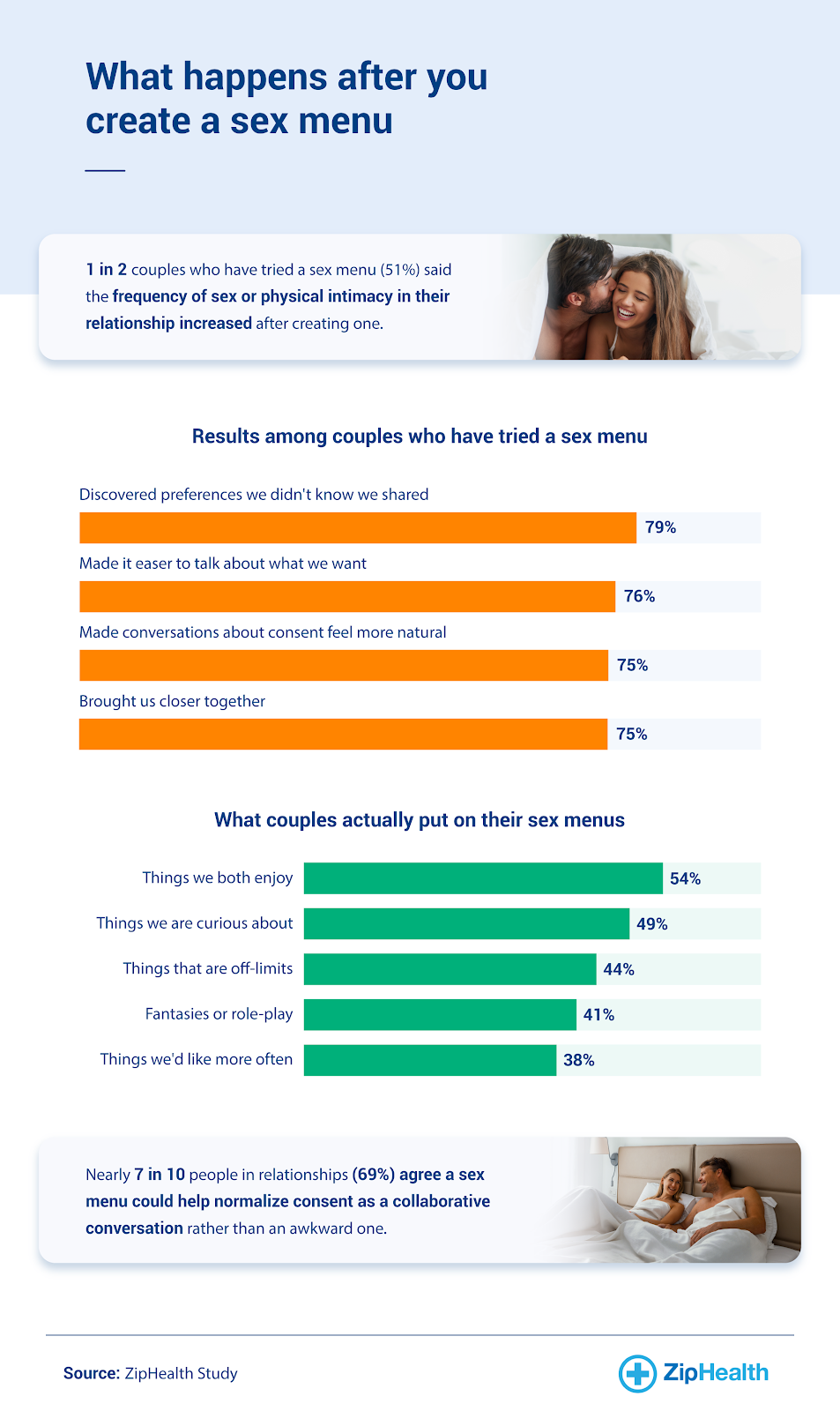
Nearly 3 in 4 couples who have tried a sex menu (74%) agreed that creating one reduces misunderstandings about what each partner wants.
- More than 2 in 5 couples who have tried a sex menu (43%) agreed it revealed differences that were difficult to navigate, while more than 1 in 3 (37%) said the process felt uncomfortable at first but became more natural over time.
- Among couples who have tried a sex menu, the decision was most often mutual (37%). However, women were more likely than men to say they initiated the idea themselves (32% vs. 24%), while men were more likely to say their partner brought it up (36% vs. 24%).
- More than 2 in 5 couples who have tried a sex menu (44%) said they revisit or update it every few months. Only 13% said they created it once and never revisited.
- 52% of people in relationships agreed that social media has made it easier to talk about sexual preferences openly, with Gen Z leading (65%) and baby boomers trailing far behind (28%).
- More than 1 in 3 people in relationships (37%) agreed they are more comfortable discussing preferences in writing than out loud.
- Baby boomers were the least likely to agree that writing down preferences is a healthy relationship practice (56%), compared to Gen Z (77%), millennials (73%), and Gen X (67%).
- 59% of people in relationships agreed that most couples would benefit from some form of structured preference-sharing, with Gen Z most likely to agree (67%) and baby boomers least likely (35%).
Methodology
We surveyed 1,008 Americans and Canadians to explore the emotional and physical intimacy gap in modern relationships. Among the 504 Americans, the average age was 40; 35% were male, 63% were female, and 1% were non-binary. Generationally, 7% were baby boomers, 21% were Gen X, 51% were millennials, and 21% were Gen Z. Among the 505 Canadians, the average age was 41; 41% were male, 58% were female, and 1% were non-binary. Generationally, 5% were baby boomers, 25% were Gen X, 54% were millennials, and 16% were Gen Z.
About ZipHealth
With ZipHealth, you can access discreet online health consultations and treatments for various conditions, including medications like Viagra and Sildenafil. We strive to provide accessible and convenient health care, ensuring you can manage your health comfortably and privately.
Fair Use Statement
This report may be shared for noncommercial purposes with proper attribution and a link back to ZipHealth. If quoting or referencing this study, please include credit to ZipHealth.