Finasteride Side Effects And How To Manage Them
Find out the most common side effects you may experience while taking finasteride, and how you can minimize them.

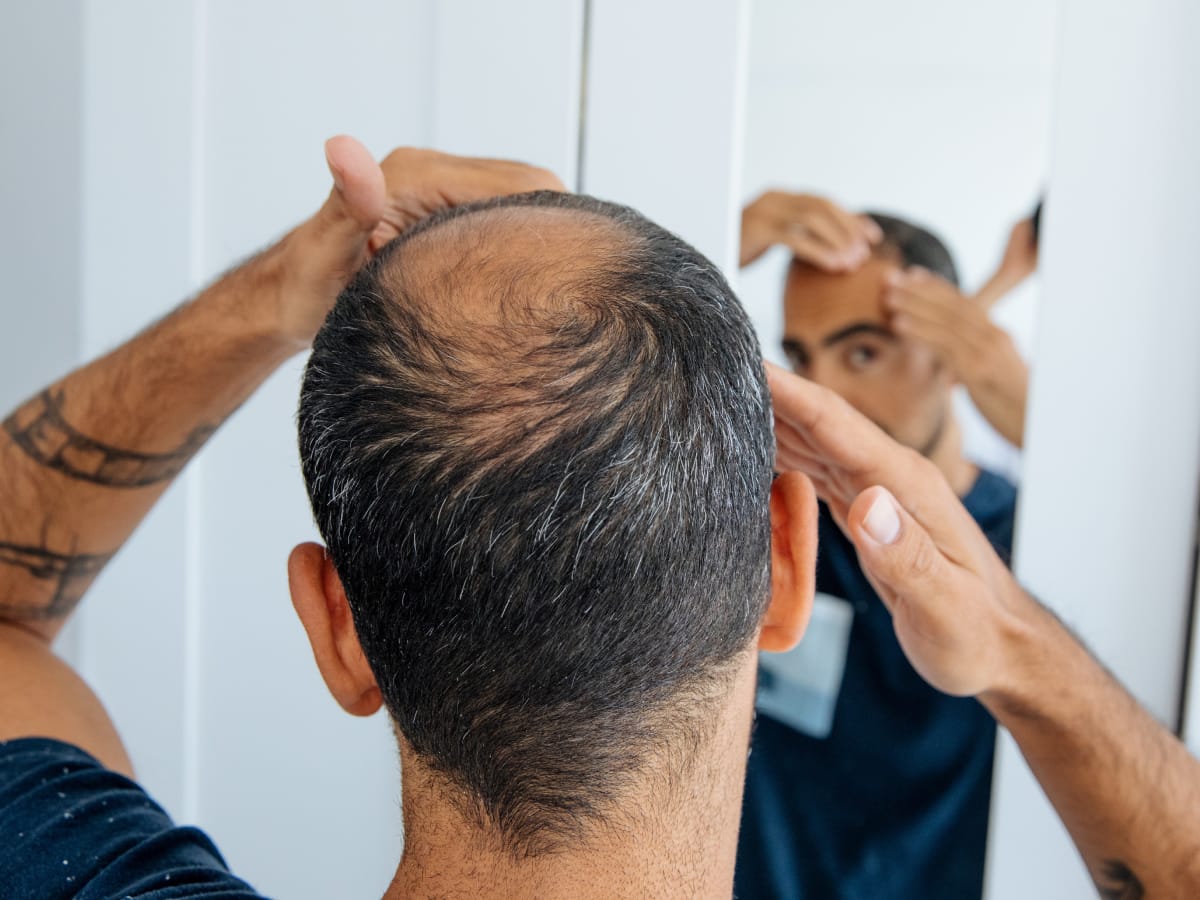
Finasteride is one of the most effective treatments for male pattern baldness, with 83% of men taking it over a two-year period finding it prevents further hair loss. [1]
But, like any medication, taking it may cause some minor side effects. It's important to be aware of these before starting treatment so you can decide whether it's right for you.
Our experts explain the common symptoms you may experience when taking finasteride and how you can manage them.
Finasteride for hair loss
Male pattern hair loss, also known as androgenetic alopecia, affects two-thirds of all American men by age 35, and 85% by age 50. [2] It has many causes, including high levels of a hormone called DHT, which comes from testosterone and makes hair follicles shrink over time.
Finasteride is a medication that helps to stop this process. It works by blocking the enzyme that turns testosterone into DHT, resulting in hair follicles that remain healthy enough to produce thick, strong strands of hair. [3]
Does finasteride have side effects?
Any drug can cause side effects, and finasteride is no exception. It’s normal for your body to take some time to adjust to a new medication, and with finasteride, any symptoms you may experience depend on the dose you take. Here are some of the side effects we’re commonly asked about, whether finasteride causes them and, if so, why they happen.
Sexual side effects
Erectile dysfunction, ejaculation changes and reduced libido are three symptoms commonly linked with taking finasteride. Research has shown you’re around 1.7 times more likely to experience sexual side effects and almost 2 times more likely to experience erectile dysfunction, compared to people not taking finasteride. [4]
However, large observational studies suggest this risk is very low in the real-world population, and the rate they occur decreases over time. [5] Here's what this could mean for you.
Erectile dysfunction
It's thought that finasteride could cause erectile dysfunction due to the roles of testosterone and DHT in maintaining penile erectile tissue. An ultrasound study of men with persistent sexual side effects after taking finasteride found that 96% of them had changes in their penile tissue.
Researchers suggested that lower DHT levels may have caused scarring in the smooth muscle of the penis, which can interrupt the blood flow needed for strong erections. [6] Reduced DHT may also affect how nerves and blood vessels communicate when you're aroused, which can make it more difficult to get or maintain an erection.
However, a study of 12,346 men with alopecia found that men taking finasteride were no more likely to experience erectile dysfunction than men who weren't taking it. [7] It's possible that side effects may be overreported due to psychosocial factors such as the "nocebo effect". This is where expecting certain side effects from a treatment can cause those effects to happen, unrelated to the medication. [8]
Ejaculation disorder
Finasteride is linked to abnormal ejaculation because it reduces levels of DHT in your bloodstream. As well as slowing hair loss, low DHT levels can also reduce the size of your prostate; for this reason, finasteride is also used to treat benign prostatic hyperplasia, or an enlarged prostate.
However, your prostate is the gland responsible for producing most of the fluid in semen, so when it gets smaller, so does your ejaculatory volume. [9] This shouldn't be cause for concern, though. Research shows finasteride has no impact on sexual dysfunction or fertility in men with normal fertility levels. [10]
Loss of libido
Many men believe low sex drive is a side effect of taking finasteride, but a survey-based study found no clear link between the drug and sexual desire. In fact, it found that men who were told about possible sexual side effects were more likely to notice and report them. [11] This may be another example of the nocebo effect, where expecting side effects can make them happen, even if the drug isn’t causing them.
Depressive symptoms
Research shows a link between starting finasteride and increased depressive symptoms. [12] A recent review found people taking finasteride were more likely to experience symptoms of depression and, in some cases, suicidal thoughts. [13]
Experts believe these thoughts are due to a direct effect the medication has on your brain. It interferes with the production of natural chemicals called neurosteroids, which helps regulate mood, reduce anxiety and support overall emotional balance. By lowering levels of neurosteroids, finasteride may contribute to depression. Interestingly, the same brain pathways that affect your mood also play a role in sexual arousal, which is why changes in sexual function and mood sometimes happen together. [14, 15]
This doesn’t mean everyone experiences mood changes with finasteride, but some people do. Because of this, it’s prescribed with care, especially if you have a history of depression. These symptoms are considered uncommon, but you should closely monitor your mood and contact your clinician if you experience any changes while taking this medication.
How to manage finasteride side effects
So, what should you do if you experience unwanted effects with finasteride? If you experience changes to your erectile function or libido, you should discuss this with your prescriber or physician. It's also safe to take PDE5 inhibitors such as sildenafil or tadalafil to treat erectile dysfunction while using finasteride.
Stop taking finasteride immediately and contact your healthcare provider as soon as possible if you develop any depressive symptoms or suicidal thoughts.
Remember, you can contact our clinical team for advice if you experience persistent side effects, or have any other concerns about your treatment.
Get support with hair loss
We can help you take back control with a clinically proven hair loss treatment. Start a consultation today.
References
- Kaufman KD, Olsen EA, Whiting D, Savin R, DeVillez R, Bergfeld W, et al. Finasteride in the treatment of men with androgenetic alopecia. Journal of the American Academy of Dermatology [Internet]. 1998 Oct 1;39(4):578–89. Available from: https://www.sciencedirect.com/science/article/abs/pii/S019096229870007
- Men’s Hair Loss [Internet]. American Hair Loss Association. Available from: https://www.americanhairloss.org/mens-hair-loss/
- McClellan KJ, Markham A. Finasteride. Drugs. 1999;57(1):111–26.
- Lee S, Lee Y, Choe S, Lee W. Adverse Sexual Effects of Treatment with Finasteride or Dutasteride for Male Androgenetic Alopecia: A Systematic Review and Meta-analysis. Acta Dermato Venereologica. 2018;0.
- Singh MK, Avram M. Persistent Sexual Dysfunction and Depression in Finasteride Users for Male Pattern Hair Loss: A Serious Concern or Red Herring? The Journal of Clinical and Aesthetic Dermatology [Internet]. 2014 Dec [cited 2025 Nov 19];7(12):51. Available from: https://pmc.ncbi.nlm.nih.gov/articles/PMC4285451/
- Rubin R, Winter A, Goldstein I. 311 Novel Penile Ultrasound Technique to Explain Mechanism of Erectile Dysfunction (ED) in Young Patients using Finasteride for Androgenic Alopecia. The Journal of Sexual Medicine. 2018 Feb 1;15(Supplement_1):S81–1.
- Hagberg KW, Divan HA, Persson R, Nickel JC, Jick SS. Risk of erectile dysfunction associated with use of 5-α reductase inhibitors for benign prostatic hyperplasia or alopecia: population based studies using the Clinical Practice Research Datalink. BMJ. 2016 Sep 22;i4823.
- Liu KE, Binsaleh S, Lo KC, Jarvi K. Propecia may induce spermatogenic failure. Fertility and Sterility. 2007 Sep;88:S394.
- Pallotti F, Senofonte G, Pelloni M, Cargnelutti F, Carlini T, Radicioni AF, et al. Androgenetic alopecia: effects of oral finasteride on hormone profile, reproduction and sexual function. Endocrine. 2020 Feb 12;68(3):688–94
- Colloca L, Miller FG. The Nocebo Effect and Its Relevance for Clinical Practice. Psychosomatic Medicine [Internet]. 2011 Sep;73(7):598–603. Available from: https://www.ncbi.nlm.nih.gov/pmc/articles/PMC3167012/
- Mondaini N, Gontero P, Giubilei G, Lombardi G, Cai T, Gavazzi A, et al. Finasteride 5 mg and sexual side effects: how many of these are related to a nocebo phenomenon? The Journal of Sexual Medicine [Internet]. 2007 Nov 1;4(6):1708–12. Available from: https://pubmed.ncbi.nlm.nih.gov/17655657/
- Rahimi-Ardabili B, Pourandarjani R, Habibollahi P, Mualeki A. Finasteride induced depression: a prospective study. BMC Clinical Pharmacology. 2006 Oct 7;6(1).
- Pompili M, Magistri C, Maddalena S, Mellini C, Persechino S, Baldessarini RJ. Risk of Depression Associated With Finasteride Treatment. Journal of Clinical Psychopharmacology. 2021 Apr 23;41(3):304–9.
- Irwig MS. Persistent Sexual and Nonsexual Adverse Effects of Finasteride in Younger Men. Sexual Medicine Reviews. 2014 Jan;2(1):24–35.
- Römer B, Gass P. Finasteride-induced depression: new insights into possible pathomechanisms. Journal of Cosmetic Dermatology. 2010 Dec;9(4):331–2.